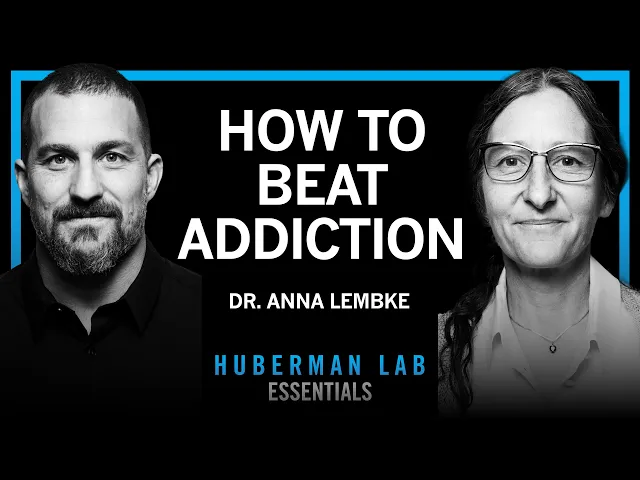
Essentials: Understanding & Treating Addiction | Dr. Anna Lembke
Andrew Huberman
26 jun 2025
Mindsip insights from this episode:
Balance pleasure and pain for optimal homeostasis
The same parts of the brain that process pleasure also process pain, and they work like a balance that always tries to restore a neutral state called homeostasis.

Reframe boredom to combat addiction in modern life
Many people with addiction are not inherently flawed but are unsuited for a modern world that is "boring" and lacks the necessary friction their brains require to be happy.
Strengthen brain circuits by practicing truthfulness
The practice of telling the truth may strengthen prefrontal cortical circuits and their connection to the brain's reward pathway, which is crucial for overcoming addiction.
Use social media intentionally to avoid its addictive nature
Social media is not a neutral tool but is engineered to be a drug, meaning we must use it with intention and pre-planned boundaries to avoid being used by it.
Understand dopamine as a baseline for pleasure and pain experience
We are always releasing dopamine at a baseline rate, and it's the deviation from this baseline, rather than isolated hits, that determines our experience of pleasure or pain.
Reset dopamine pathways with a 30-day fast
It takes an average of 30 days of abstinence from a high-dopamine substance or behavior for the brain to reset its reward pathways and regenerate dopamine transmission.
Prepare for initial discomfort during dopamine fast
When starting a dopamine fast, you will likely feel worse for the first two weeks before you start feeling significantly better in weeks three and four.
Recognize severe addiction as an unconscious reflex
In severe addiction, the brain's pleasure-pain balance can be permanently broken, making relapse a reflexive action like scratching an itch in your sleep, not a conscious choice.
Recognize positive triggers to prevent relapse
Triggers for relapse are not only negative events; positive experiences can also be triggers because the associated dopamine release can reactivate the craving cycle.
More from
Andrew Huberman
Optimizing Workspace for Productivity, Focus & Creativity | Huberman Lab Essentials
Best Ways to Build Better Habits & Break Bad Ones | James Clear
Essentials: Micronutrients for Health & Longevity | Dr. Rhonda Patrick
Defining Healthy Masculinity & How to Build It | Terry Real
Essentials: How to Optimize Your Hormones for Health & Vitality | Dr. Kyle Gillett
You also might be interested in
This Brain Trick Feels Like Cheating (Do THIS)
This Is Why You Break Every New Year’s Resolution — And How To Finally Stop | Shadé Zahrai
Why Mental Illness Is a Metabolic Problem—and What That Means for Your Health | Dr. Chris Palmer
Mark Manson's No Bullsh*t Guide To Real Change In 2026
Your New Year’s Goals Won’t Work — Here’s What Will