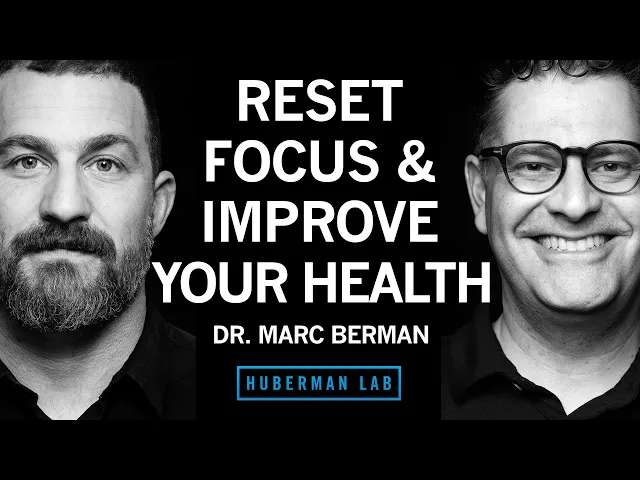
How Nature & Other Physical Environments Impact Your Focus, Cognition & Health | Dr. Marc Berman
Andrew Huberman
14 jul 2025
Mindsip insights from this episode:
Avoid passive activities that drain your attention resources
Low cognitive demand activities like scrolling social media or watching television are not restorative and actually deplete your finite directed attention resources.

Restore attention by immersing in nature
Going into nature restores your finite 'directed attention' by softly engaging your inexhaustible 'involuntary attention,' which is captured by interesting things like waterfalls or rustling leaves.
Experience cognitive restoration from any nature walk, regardless of enjoyment
You receive the same cognitive restoration from a walk in nature even if you don't enjoy it, such as walking in the freezing cold, suggesting the benefit is not simply mood-driven.
Engage with nature's patterns for mental ease
Our brains process the fractal patterns and redundant information in nature more efficiently, similar to how a JPEG file is compressed, which is why it feels less mentally taxing.
Take a 20-minute nature walk to restore focus
A 20-minute solitary walk in nature, without your phone or music, is a highly effective protocol for restoring your ability to focus.
Utilize nature walks to enhance cognitive benefits in depression
Individuals with clinical depression who were prompted to ruminate received even stronger cognitive benefits from a nature walk than non-depressed individuals.
Engage with curved edges to inspire spiritual reflection
Simply viewing images with more curved edges, even when scrambled beyond recognition, causes people to think more about spirituality and their life journey.
Train your focus through meditation, not rest
Unlike a restorative nature walk, meditation is a form of focus training that actively uses, rather than replenishes, your directed attention.
Experience nature to achieve a restful brain state
Being in nature may push the brain into a more 'fractal' state of activity, which is a neurological sign of exerting less cognitive effort and being in a rested state.
More from
Andrew Huberman
Optimizing Workspace for Productivity, Focus & Creativity | Huberman Lab Essentials
Best Ways to Build Better Habits & Break Bad Ones | James Clear
Essentials: Micronutrients for Health & Longevity | Dr. Rhonda Patrick
Defining Healthy Masculinity & How to Build It | Terry Real

Essentials: How to Optimize Your Hormones for Health & Vitality | Dr. Kyle Gillett
You also might be interested in
This Brain Trick Feels Like Cheating (Do THIS)
This Is Why You Break Every New Year’s Resolution — And How To Finally Stop | Shadé Zahrai
Why Mental Illness Is a Metabolic Problem—and What That Means for Your Health | Dr. Chris Palmer
Mark Manson's No Bullsh*t Guide To Real Change In 2026
Your New Year’s Goals Won’t Work — Here’s What Will