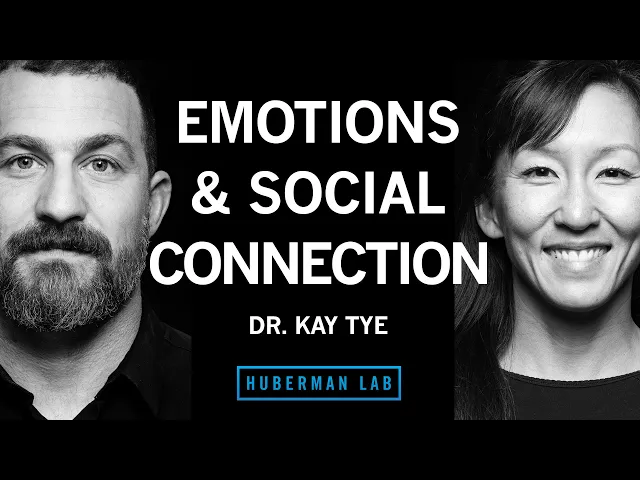
The Biology of Social Interactions & Emotions | Dr. Kay Tye
Andrew Huberman
5 feb 2024
Mindsip insights from this episode:
Limit email and social media to one hour weekly for creativity
To preserve creativity and mental clarity, Dr. Kay Tai limits her email and social media consumption to less than one hour per week, allowing her to avoid cognitive clutter and have creative epiphanies.

Adjust social interactions to maintain balance in social appetite
The concept of "social homeostasis" suggests your need for social interaction is dynamic, where a period of isolation can lower your set point, making you feel overstimulated by what was previously a normal amount of contact.
Recognize social media's role in increasing loneliness
Because social media often shows you activities from which you are excluded, it may fail to satisfy the need for social connection and instead create a feeling of withdrawal or deficit.
Decode brain activity to predict competitive outcomes
Researchers can predict which animal will win a competitive interaction by decoding prefrontal cortex activity seconds before the trial even begins, suggesting the outcome is not determined solely during the event.
Explore psychedelics to bridge self and other for unity
A scientific hypothesis for the effects of psychedelics is that they reduce the quantifiable distance between the brain's neural representations of "self" and "other," which could explain feelings of unity.
Recognize amygdala's role in signaling reward and fear
The amygdala is not just a fear center but a fork in the road for emotional processing, with distinct neurons that signal both positive (reward) and negative (punishment) outcomes.
Shift priorities: food reward overrides fear in starvation
In a state of near-starvation, the brain can shift its priorities so that the drive for food reward becomes stronger and can silence the fear pathway, inverting the typical survival hierarchy.
Address chronic isolation to prevent antisocial behavior
While acute social isolation leads to a rebound of pro-social behavior, chronic isolation in humans, monkeys, and mice can lead to aggression and avoidance upon reintroduction to a group.
More from
Andrew Huberman
Optimizing Workspace for Productivity, Focus & Creativity | Huberman Lab Essentials
Best Ways to Build Better Habits & Break Bad Ones | James Clear
Essentials: Micronutrients for Health & Longevity | Dr. Rhonda Patrick
Defining Healthy Masculinity & How to Build It | Terry Real
Essentials: How to Optimize Your Hormones for Health & Vitality | Dr. Kyle Gillett
You also might be interested in
This Brain Trick Feels Like Cheating (Do THIS)
This Is Why You Break Every New Year’s Resolution — And How To Finally Stop | Shadé Zahrai
Why Mental Illness Is a Metabolic Problem—and What That Means for Your Health | Dr. Chris Palmer
Mark Manson's No Bullsh*t Guide To Real Change In 2026
Your New Year’s Goals Won’t Work — Here’s What Will