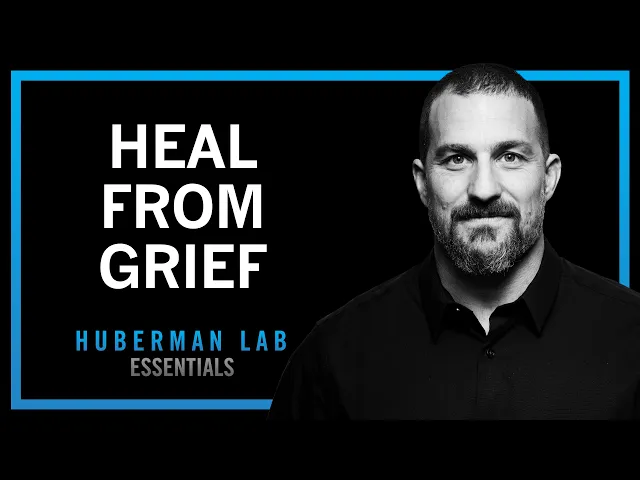
The Science & Process of Healing from Grief | Huberman Lab Essentials
Andrew Huberman
May 28, 2026
Episode description
In this Huberman Lab Essentials episode, I explain the neuroscience of grief, including how the brain maps relationships across three dimensions — space, time, and closeness — and why losing someone requires a remapping of those neural circuits. I describe how grief differs from depression, the role of oxytocin in driving yearning after a loss, and why people move through grief at different rates. I also discuss science-based tools for grieving adaptively, including how to access feelings of attachment while decoupling them from episodic memory. Finally, I explain how foundational biology — particularly sleep and cortisol rhythms — shapes our capacity to navigate the grieving process.
Show notes: https://go.hubermanlab.com/RtAnILi
Watch more Huberman Lab Essentials: https://youtube.com/playlist?list=PLPNW_gerXa4OGNy1yE-W9IX-tPu-tJa7S&si=a1_sA7rUT-fE0OM5
Follow Huberman Lab
Instagram: https://www.instagram.com/hubermanlab
Threads: https://www.threads.net/@hubermanlab
X: https://x.com/hubermanlab
Facebook: https://www.facebook.com/hubermanlab
TikTok: https://www.tiktok.com/@hubermanlab
LinkedIn: https://www.linkedin.com/in/andrew-huberman
Website: https://www.hubermanlab.com
Newsletter: https://www.hubermanlab.com/newsletter
Timestamps
00:00:00 Grief
00:01:47 Myths of Grief, Kubler-Ross & fMRI
00:03:56 Brain Mapping Experiment, Proximity
00:07:05 Inferior Parietal Lobule; Space, Time & Closeness
00:09:20 Episodic Memory & Remapping After Loss
00:13:41 Tool: Dedicated Time, Counterfactual Thinking & Guilt
00:15:30 Oxytocin & Individual Differences in Grief
00:16:30 Prairie Voles, Monogamy & Nucleus Accumbens
00:21:58 Vagal Tone, Emotional Disclosure & Bereavement Writing Study
00:26:51 Cortisol Rhythms, Complicated Grief & Sunlight
00:30:57 Rational Grieving, Neuroplasticity & NSDR
#hubermanlab #science #health #grief
Disclaimer & Disclosures: https://www.hubermanlab.com/disclaimer
Mindsip insights from this episode:
Maintain attachment to navigate grief effectively
The most adaptive way to move through grief is to maintain and feel the attachment to the person you lost, while consciously working to remap the space and time dimensions.

Utilize NSDR to enhance neuroplasticity during grief
Non-Sleep Deep Rest (NSDR) protocols can be used to accelerate the neuroplasticity required to rewire brain connections during the grieving process.
Rethink five stages of grief as a universal model
Modern neuroimaging and psychological evaluation show that the famous five stages of grief by Kubler-Ross are not a universally accurate model for the grieving process.
Understand biological basis of intense yearning in grief
People who experience intense yearning for a lost person may have more oxytocin receptors in the brain's motivation and craving centers, such as the nucleus accumbens.
Decouple attachment from outdated mental maps during grief
The process of grieving is the difficult work of uncoupling our deep feelings of attachment from the now-incorrect mental maps of where a person is in space and time.
Manage cortisol levels to address complicated grief
People experiencing complicated grief have been shown to have significantly higher cortisol levels at 4 p.m. and 9 p.m., disrupting the natural daily rhythm.
Leverage high vagal tone to enhance grief processing through writing
Individuals with higher vagal tone, who can better regulate their heart rate with breathing, may benefit more from emotional writing exercises to process grief.
Understand brain's 3D mapping of relationships
Our brain maps our experience of people using three interwoven dimensions: their location in physical space, their place in time, and our emotional closeness to them.
More from
Andrew Huberman
How to Improve Your Memory & Cognitive Function at Any Age | Dr. Alan Castel

Raising a Dog & Mastering Calm Assertive Energy | Cesar Millan

Essentials: Tools for Hormone Optimization in Males | Dr. Kyle Gillett

Movement Practice to Strengthen Your Mind-Body Connection | Ido Portal

Essentials: The Science of Eating for Health, Fat Loss & Lean Muscle | Dr. Layne Norton
You also might be interested in

Jordan Harbinger: Fight-or-Flight, Two Kidnappings, and the Wallet Ruining Your Spine
How Brain Inflammation Drives Depression, Alzheimer's, and Parkinson's

Danny McBride on Leaving Hollywood, the Collapse of Comedy & Doomscrolling’s Impact
Your Nervous System Controls Your Gut, Hormones, and Weight — Here's How to Fix It

I Tried EVERY Legal Focus Drug, Here’s What Actually Works