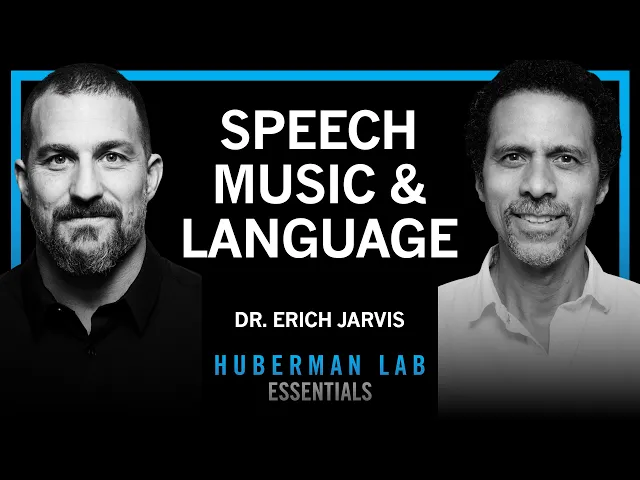
Essentials: The Neuroscience of Speech, Language & Music | Dr. Erich Jarvis
Andrew Huberman
Apr 23, 2026
Episode description
In this Huberman Lab Essentials episode, my guest is Dr. Erich Jarvis, PhD, a professor and Head of the Laboratory of Neurogenetics of Language at Rockefeller University and an investigator at the Howard Hughes Medical Institute (HHMI). We discuss the brain circuits and genes underlying spoken language and why the ability to learn and produce vocalizations is extraordinarily rare in the animal kingdom. We also explore why song likely evolved before language, how gesture and movement share deep neural roots with speech, the neurobiology of stuttering, why childhood is the optimal window for language acquisition, and how physical movement — including dance — may help preserve speech and cognitive function across a lifetime.
Show notes: https://go.hubermanlab.com/C1XC6tO
Watch more Huberman Lab Essentials: https://youtube.com/playlist?list=PLPNW_gerXa4OGNy1yE-W9IX-tPu-tJa7S&si=a1_sA7rUT-fE0OM5
Huberman Lab
Instagram: https://www.instagram.com/hubermanlab
Threads: https://www.threads.net/@hubermanlab
X: https://x.com/hubermanlab
Facebook: https://www.facebook.com/hubermanlab
TikTok: https://www.tiktok.com/@hubermanlab
LinkedIn: https://www.linkedin.com/in/andrew-huberman
Website: https://www.hubermanlab.com
Newsletter: https://www.hubermanlab.com/newsletter
Dr. Erich Jarvis
Dr. Erick Jarvis' Lab: https://www.jarvislab.net
Rockefeller University: https://www.rockefeller.edu/our-scientists/heads-of-laboratories/1159-erich-d-jarvis
Google Scholar: https://scholar.google.com/citations?user=cI-fi9MAAAAJ
X: https://x.com/erichjarvis
Instagram: https://www.instagram.com/erich_d_jarvis
LinkedIn: https://www.linkedin.com/in/erich-jarvis-ba73624
Timestamps
00:00:00 Speech & Language
00:00:23 Speech vs. Language; Brain Pathways
00:02:07 Gesture, Movement & Language Evolution
00:04:31 Emotion, Innate Sounds & Vocal Learning
00:06:50 Evolution of Spoken Language
00:07:04 Neanderthals & the Origins of Human Language
00:08:17 Songbird & Human Speech Circuits Compared
00:09:08 Critical Periods & Vocal Learning in Birds
00:10:55 Convergent Evolution; Genes & Speech Circuits
00:13:20 Innate Predisposition to Learn; Birdsong Dialects
00:15:39 Pidgin Language & Cultural-Genetic Evolution
00:17:46 Genes Controlling Speech Pathways
00:20:30 Critical Periods & Multilingualism
00:22:41 Music, Emotion & Semantic vs. Affective Communication
00:25:38 Facial Expression & Speech Circuits
00:27:28 Written Language & Neural Circuitry
00:28:53 Stuttering; Basal Ganglia & Neurogenesis
00:31:09 Texting, Technology & Language Change
00:32:42 Tool: Movement, Dance & Cognitive Health
00:34:49 Recap
Disclaimer & Disclosures: https://www.hubermanlab.com/disclaimer
Mindsip insights from this episode:
Acknowledge Neanderthals' spoken language through genetic evidence
Based on genetic data from fossils, Neanderthals had the same gene sequences involved in speech circuits as modern humans, suggesting they possessed spoken language.
Engage in movement to maintain cognitive sharpness
To stay cognitively intact into old age, you must consistently engage in physical movement like dancing or walking, as the brain circuits for movement and cognition are interconnected.

Protect speech circuits from cellular stress
Neurons in speech pathways have more neuroprotective proteins because controlling the larynx requires them to fire much faster, creating more potential cellular stress.
Turn off genes to unlock speech evolution
The evolution of speech involved turning off specific genes that normally prevent certain neural connections, allowing new, crucial pathways for vocal control to form.
Retain diverse sounds to ease adult language learning
People who learn multiple languages as children find it easier to learn more as adults not because of greater brain plasticity, but because they've retained a wider range of sounds.

Explore singing as the precursor to human language
A leading hypothesis is that human language first evolved for emotional expression through singing, and only later was adapted for abstract, semantic communication.
Connect speech evolution to body movement circuits
The brain pathways that control speech are thought to have evolved from the brain pathways that control body movement, which is why we often gesture unconsciously while talking.
Engage brain pathways while reading silently
When you read silently, your brain sends signals to your speech pathways to 'speak' the words, and then to your auditory pathways to 'hear' them in your head.

More from
Andrew Huberman
How to Improve Your Memory & Cognitive Function at Any Age | Dr. Alan Castel

Raising a Dog & Mastering Calm Assertive Energy | Cesar Millan

Essentials: Tools for Hormone Optimization in Males | Dr. Kyle Gillett

Movement Practice to Strengthen Your Mind-Body Connection | Ido Portal

Essentials: The Science of Eating for Health, Fat Loss & Lean Muscle | Dr. Layne Norton
You also might be interested in

Organic Produce, Exercise vs Income, Cat Parasite, Thorne, Loss of Taste, and more...

Could ONE Score Reveal How Fast You’re Aging? The Longevity Quotient & How a Former NFL Player Is Redefining The Standards of Longevity Medicine, With Jimmy St. Louis

Biohacking Gadgets You’ve Never Heard Of (& A Preview of The World’s TOP Health Optimization Event) With Tim Gray

Can A *Frequency* Simulate Nicotine, Caffeine, Melatonin, THC & Alcohol (+ Fixing Broken Knees WITHOUT Surgery?!) with Dr. Pradeep Albert

Eat These Foods + Spices for 8 Weeks To Get 3 Years Younger | Kara Fitzgerald