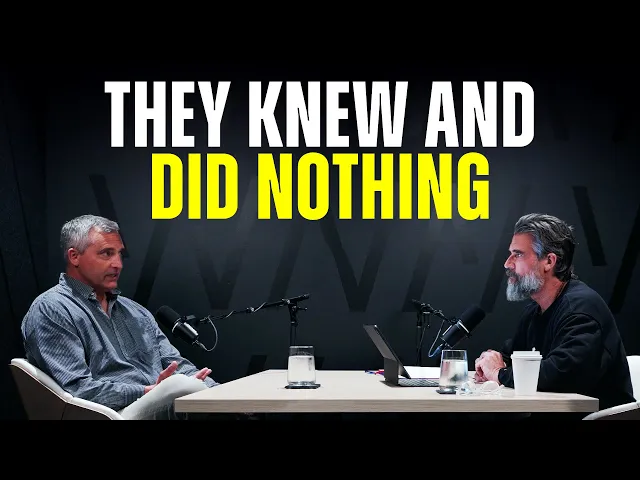
The Olympic Lie: What They Don't Tell You
Rich Roll
Jul 28, 2025
Episode description
Peter Carlisle is a veteran sports agent whose clients include Michael Phelps and Simone Biles. We discuss the hidden mental health crisis behind Olympic gold, youth sports specialization, the Weight of Gold documentary, and more. READ MORE👉 http://bit.ly/richroll925
✌🏼🌱 - Rich
This Episode Is Brought To You By…
On: High-performance shoes & apparel crafted for comfort and style👉https://bit.ly/ONXRRP2025
BetterHelp: Get 10% OFF the first month👉https://bit.ly/betterhelp2025rrp
Audience Survey: Help us improve the show by sharing what matters most to you👉https://www.richroll.com/survey
Go Brewing: Use code Rich Roll for 15% OFF 👉https://bit.ly/gobrewing2025
iFit: Use code RICHROLL to get 10% off any purchase of $999+👉https://bit.ly/rrnordictrack
Check out all of the amazing discounts from our Sponsors 👉🏾 https://bit.ly/rrpsponsors
LISTEN / SUBSCRIBE TO THE PODCAST
Apple Podcasts: http://bit.ly/rrpitunes
Spotify: http://bit.ly/rrpspotify
Google: http://bit.ly/rrpgooglepods
Meal Planner: http://meals.richroll.com
Voicing Change Book: http://richroll.com/vc
Clips Channel: https://www.youtube.com/c/RichRollPodcastClips
Newsletter: http://bit.ly/rollcallemail
CHAPTERS
00:00:00 Start
00:00:44 Introduction & Setting the Stage
00:01:41 Diversity vs. Specialization in Sports
00:03:55 Rise of Early Specialization in Youth Sports
00:05:11 Identity Formation & Pressures on Young Athletes
00:06:31 Transition Challenges for Elite Athletes
00:08:27 Post-Olympic Blues & Athlete Transitions
00:10:46 Personal Experience with Youth Sports Specialization
00:14:08 Systemic Pressures & Commercialization of Youth Sports
00:15:16 Social Media, NIL, and Modern Athlete Pressures
00:16:04 Mental Health Advocacy by Elite Athletes
00:16:45 Governing Bodies’ Response to Mental Health
00:19:24 Disconnect Between Athletes and Governing Bodies
00:24:37 Stigma & Isolation in Athlete Mental Health
00:26:24 Michael Phelps’ Public Disclosure & Impact
00:31:48 Finding Purpose Beyond Athletic Achievement
00:32:19 Transferability of Athletic Skills to Life
00:36:13 Perspective Shift: Process Over Results
00:36:36 The Weight of Gold Documentary
00:41:11 Parental Strategies & Limits of Influence
00:45:22 Specialization as an Unavoidable Reality
00:46:43 Zen Philosophy & Process-Oriented Mindset
00:48:30 Mastery, Presence, and Emotional Regulation
00:57:01 Visualization & Emotional State in Performance
00:57:55 Signing Michael Phelps: The Origin Story
01:00:51 Philosophy of Athlete Representation
01:03:17 Olympic vs. Professional Athlete Representation
01:04:24 Building Athlete Brands & Social Media
01:06:17 Social Media’s Double-Edged Sword
01:08:49 AI, NIL, and the Future of Athlete Marketing
01:10:57 Looking Ahead to LA 2028 Olympics
01:13:34 Common Traits of Elite Athletes
01:15:21 The Dark Side of Competitive Drive
01:18:55 Balancing Excellence and Well-being
01:20:05 Process vs. Results: Lessons from Pitching
01:22:14 Reframing Failure as Growth
01:23:05 Win or Learn: Embracing Growth Mindset
01:23:54 Limits of Compartmentalization & Path to Mastery
01:28:01 Policy Changes for Youth Sports
01:31:23 Responsibility for Athlete Well-being
01:32:23 Cultural Shift in Mental Health Conversations
01:32:48 Conclusion & Appreciation
CONNECT WITH RICH
✩ Website - http://richroll.com
✩ Rich Roll Podcast - https://richroll.com/all-episodes/
✩ Instagram - https://www.instagram.com/richroll/
✩ Twitter - https://twitter.com/richroll
✩ Facebook - https://www.facebook.com/richrollfans
✩ Strava - https://www.strava.com/athletes/14443?oq=rich
✩ Memoir: Finding Ultra - https://www.richroll.com/shop/books/finding-ultra/
✩ Meals - http://meals.richroll.com
✩ Cook - The Plantpower Way - https://www.richroll.com/shop/books/the-plantpower-way-signed/
✩ Italian! - The Plantpower Way: Italia - https://www.richroll.com/shop/books/the-plantpower-way-italia-signed/
✩ Support - https://www.patreon.com/richroll
FILMED AND EDITED BY DAN DRAKE
https://www.dandrake333.com/
* * * * *
NEW TO RICH?
Hi I'm Rich Roll. I'm a vegan ultra-endurance athlete, author, podcaster, public speaker & wellness evangelist. But mainly I'm a dad of four. If you want to know more, visit my website or check out these two the NY Times articles:
http://bit.ly/otillonyt
http://bit.ly/vegansglam
I LOVE MAIL! SEND IT HERE:
2630 Conejo Spectrum St.
Thousand Oaks, CA 91320
#richroll #richrollpodcast
Mindsip insights from this episode:
Focus on athletes who hate to lose for Olympic success
According to a legendary coach, the Olympic team is comprised of the 20% of athletes who hate to lose, rather than the 80% who love to win.

Recognize insecurity as a driver of elite performance
The intense competitiveness and "hate to lose" mentality of many top performers is often driven by ego and insecurity, which can be a double-edged sword for mental health.

Master your mind and build resilience through specialization in sports
You can use specialization not to master a result, like hitting a target, but as a process to master your own mind and build resilience.
Transform desperation into strength by sharing mental health struggles
Michael Phelps's decision to first speak openly about his mental health struggles was not a calculated plan but an act of desperation that ultimately made him feel stronger.
Visualize desired emotions for competitive success
A powerful visualization technique is to rehearse the desired emotional state you want to feel during competition, such as calm and confidence, rather than just the physical movements.
Reconnect national governing bodies with athletes' needs for development
National governing bodies are often disconnected from athletes' daily struggles, as their primary focus is on marketing the sport and generating sponsorships, not athlete development.
Address post-Olympic blues for smoother transitions
The overwhelming majority of Olympic athletes suffer from "post-Olympic blues," a very difficult transition back to normal life after the games, regardless of their performance.
Recognize irrelevance of elite athletic skills in life
The specific skills that separate the best athletes from the great ones, like being a fraction of a second faster, are often completely irrelevant and non-transferable to the rest of life.

Confront void after winning Olympic gold medal
Winning an Olympic gold medal can be more problematic than losing because it eliminates the one potential answer to an athlete's problems, often leaving a void.
More from
Rich Roll

Danny McBride on Leaving Hollywood, the Collapse of Comedy & Doomscrolling’s Impact

Pro Athlete Performance Doctor on Nicotine, Peptides, Wearables, and Expensive Youth Sports

What killed the vegan movement

Radiohead’s Ed O’Brien Opens Up About Depression, Fatigue & Childhood Trauma

Why Life Feels Meaningless and How to Feel Alive Again
You also might be interested in
How to Improve Your Memory & Cognitive Function at Any Age | Dr. Alan Castel

Jordan Harbinger: Fight-or-Flight, Two Kidnappings, and the Wallet Ruining Your Spine
How Brain Inflammation Drives Depression, Alzheimer's, and Parkinson's
Your Nervous System Controls Your Gut, Hormones, and Weight — Here's How to Fix It
I Tried EVERY Legal Focus Drug, Here’s What Actually Works