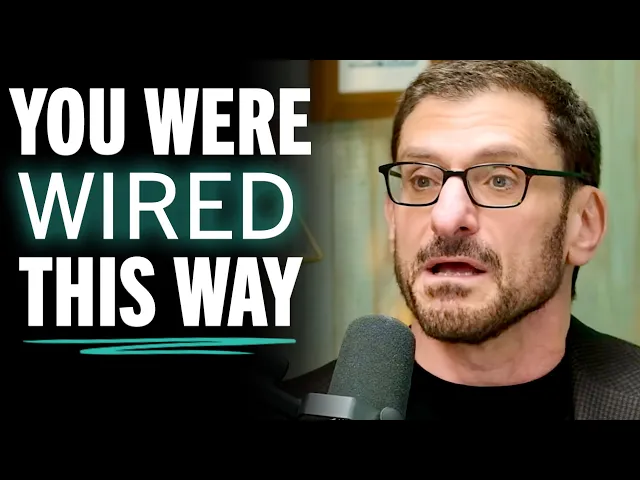
Why You Feel Insecure in Relationships (And It’s NOT Your Fault) | Dr. Amir Levine
Rangan Chatterjee
Apr 8, 2026
Episode description
This episode is brought to you by:
AG1: Get FREE AG1 Flavour Sampler, AGZ Sampler, Vitamin D3+K2 and Welcome Kit with your first AG1 subscription (worth $87, US only) https://bit.ly/43FwxQl
BON CHARGE: Save 20% off all Bon Charge products with code LIVEMORE https://boncharge.com/livemore
THE WAY APP: Get 30 FREE sessions and begin your journey towards peace, calm and wellbeing. https://thewayapp.com/livemore
What if the secret to great health, more energy and feeling happier isn’t a diet, a fitness routine or a supplement – but the quality of your relationships? This conversation, with neuroscientist Dr Amir Levine, will challenge your preconceptions about how you relate to others and, more importantly, empower you to change that.
Dr Levine is Associate Professor of Clinical Psychiatry at Columbia University and bestselling author of Attached – a landmark title about attachment theory in adults. But it’s his new book Secure: The Revolutionary Guide to Creating a Secure Life, that we’re diving into today. In it, he makes the case that all of us, no matter what our attachment style, can learn to build relationships that help us thrive – in all areas of our life.
Not familiar with the four attachment styles? Dr Levine explains all and tells us how they might show up in everyday life. They aren’t disorders that need to be fixed, but natural variations in how we understand and interact with others. And getting to know yours could help you feel more secure in your relationships, work and wellbeing.
We explore the evolutionary science behind why our brains, which are wired for connection, can experience social exclusion as physical pain. It’s what makes ignoring someone just as damaging as lashing out – and explains why positive interactions with strangers (a hello here, a wave there) don’t just make your day, they can actually change your brain’s structure over time.
If, as Dr Levine reveals, 95 percent of our adult attachment has nothing to do with childhood, that means we have huge potential for change. We don’t have to be held back by patterns we thought were with us for life. We just need to play to our strengths in relationships – and give our brains the right signals in the present.
And if that sounds promising but puzzling, Dr Levine shares lots of practical ideas and tools you can use right away – including his five pillars of secure attachment and two, game-changing rules for managing conflict. We also discuss why some common ideas, like seeking closure after a break-up or setting boundaries, might not offer the security you’d like.
What I hope you’ll take from this conversation is a sense of optimism. It’s the ideal episode for anyone feeling stuck in a relationship, struggling with conflict, or who simply wants to feel more secure in themselves.
#feelbetterlivemore
Find out about Dr Levine:
Website https://www.amirlevinemd.com/
Dr Levine’s books:
Secure: The Revolutionary Guide to Creating a Secure Life UK https://amzn.to/486u3PF US https://amzn.to/4tCadEe
Attached: How the science of adult attachment can help you find – and keep - love UK https://amzn.to/4cc5sda US https://amzn.to/4tyWaPD
#feelbetterlivemore #feelbetterlivemorepodcast
-------
Order MAKE CHANGE THAT LASTS. US & Canada version https://amzn.to/3RyO3SL, UK version https://amzn.to/3Kt5rUK
-----
Follow Dr Chatterjee at:
Website: https://drchatterjee.com/
Facebook: https://www.facebook.com/drchatterjee
Twitter: https://twitter.com/drchatterjeeuk
Instagram: https://www.instagram.com/drchatterjee/
Newsletter: https://drchatterjee.com/subscription
DISCLAIMER: The content in the podcast and on this webpage is not intended to constitute or be a substitute for professional medical advice, diagnosis, or treatment. Never disregard professional medical advice or delay in seeking it because of something you have heard on the podcast or on my website.
Mindsip insights from this episode:
Challenge the myth of closure after a breakup
The intense need for "closure" after a breakup is often a myth driven by the brain's attachment system trying to re-engage, not a genuine path to moving on.

Recognize social exclusion as a source of pain
The brain is programmed to experience social exclusion as being on par with physical pain, a primal reaction that cannot be overridden by logic or financial incentives.
Implement one upset rule to resolve arguments effectively
A practical rule for arguments is that only one person is allowed to be upset at a time, and the other person's primary role is to help them calm down.

Leverage anxious attachment as a superpower for heightened awareness
Rather than a flaw, an anxious attachment style can be a superpower, as it correlates with a heightened sensitivity that helps identify dangers and notice subtle cues others miss.
Recognize boundaries as symptoms of insecure attachment
The need to set rigid boundaries is often a symptom of an insecure attachment; a truly secure relationship naturally anticipates and meets each other's needs without them.
Reduce insecurity to conserve brain energy for creativity
Feeling insecurely attached keeps the brain in a high-vigilance state that drains a significant amount of energy, which could otherwise be used for creativity and exploration.
Transform adult attachment styles regardless of childhood experiences
Research shows that around 95% of adult attachment style cannot be explained by childhood attachment, offering significant hope for change at any age.
Acknowledge emotional connection to avoid aggression in relationships
Intentionally ignoring a partner or friend is an incredibly aggressive act that can be as harmful as lashing out because it severs the emotional connection our brain relies on for safety.
Apologize together to restore emotional equilibrium in relationships
If both people in a relationship get upset simultaneously, they should both apologize for mutually failing to maintain the relationship's emotional equilibrium.
Leverage small interactions to reshape your brain and attachment style
Seemingly Insignificant Minor Interactions (SIMIS) of everyday life are powerful opportunities to structurally change your brain and build a more secure attachment style over time.
More from
Rangan Chatterjee

Sleep Doctor: If You Wake Up Between 1–3 AM, Your Body Is Trying To Warn You | Dr Michael Breus

The Invisible Trap: Evidence You're Living the Wrong Life (& Don't Know It) | Professor C Thi Nguyen

Chronic Stress Is Aging Your Body Faster Than Smoking (Here's How To Reverse It) | Dr Elissa Epel

If You Have These 5 Traits, You Are Far More Protected From Dementia

#1 Aging Expert: Dementia, Diabetes & Heart Disease Start After 40 When You Ignore This
You also might be interested in
How to Improve Your Memory & Cognitive Function at Any Age | Dr. Alan Castel

Jordan Harbinger: Fight-or-Flight, Two Kidnappings, and the Wallet Ruining Your Spine
How Brain Inflammation Drives Depression, Alzheimer's, and Parkinson's

Danny McBride on Leaving Hollywood, the Collapse of Comedy & Doomscrolling’s Impact
Your Nervous System Controls Your Gut, Hormones, and Weight — Here's How to Fix It