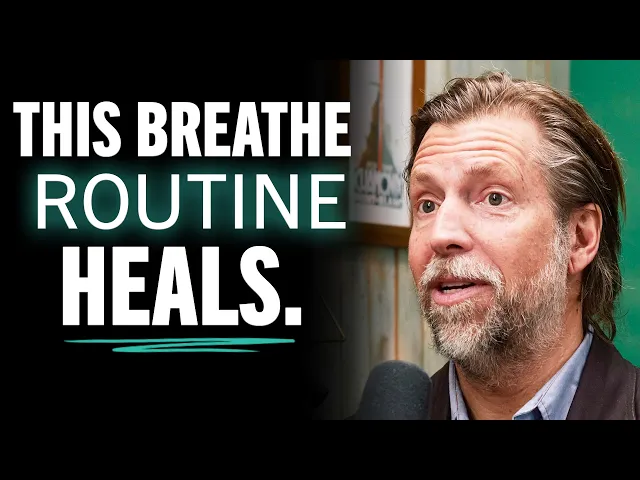
If You Breathe Like This, Don’t Ignore It- It’s Costing You Your Sleep, Brain & Health: James Nestor
Rangan Chatterjee
Apr 1, 2026
Episode description
This episode is brought to you by:
AG1: Get FREE AG1 Flavour Sampler, AGZ Sampler, Vitamin D3+K2 and Welcome Kit with your first AG1 subscription (worth $87, US only) https://bit.ly/43FwxQl
VIVOBAREFOOT: Get 15% off your first order https://links.drchatterjee.com/4nqvRI3
Listening to this conversation could help you sleep better, quit snoring, and wake refreshed. You’ll learn a simple trick to stop anxiety in its tracks, and find out how to keep asthma and high blood pressure in check. And the secret to all these health gains? It really is a breath of fresh air…
I’m talking to James Nestor, a science journalist and the author of international bestseller Breath: The New Science of a Lost Art. James spent a decade investigating why so many of us breathe badly and what happens when we get it right. And he’s here today to pass on some ancient wisdom, through the lens of modern science.
We all know the feeling of shallow, rapid breathing that sets in when you’re anxious or stressed. And you don’t have to be a breathwork guru to recognise the power of a slow inhalation and exhalation to make you feel… ahh… grounded and calm. James’s message is that better breathing really is that simple. It’s about tuning in to how well you’re using your lungs, your diaphragm – and your nose.
In this episode, we get into why something as simple as switching from mouth breathing to nasal breathing could transform your health. We talk about a fascinating piece of research showing that lung size could be the single biggest predictor of how long you live. James shares the evidence that many chronic and unexpected health conditions can be improved and even reversed through better breathing – something doctors aren’t taught and don’t tell you. And he measures the CO2 levels in my studio, which leads to a conversation about indoor air quality that I was not expecting. It might change the way you think about your home, your office, your airline choice and your next hotel room.
Perhaps the most exciting thing about this conversation is how simple and accessible everything we discuss is. The foundations of healthy breathing don’t cost a thing. You don’t need a gadget, a retreat, or a prescription. You just need to unlearn some key habits and start making small changes – for big results.
#feelbetterlivemore
Connect with James:
Website https://www.mrjamesnestor.com/
https://www.instagram.com/mrjamesnestor/
https://www.facebook.com/mrjamesnestor
James’s book:
Breath: The New Science of a Lost Art UK https://amzn.to/4tctHik US https://amzn.to/4uZC5Ub
#feelbetterlivemore #feelbetterlivemorepodcast
-------
Order MAKE CHANGE THAT LASTS. US & Canada version https://amzn.to/3RyO3SL, UK version https://amzn.to/3Kt5rUK
-----
Follow Dr Chatterjee at:
Website: https://drchatterjee.com/
Facebook: https://www.facebook.com/drchatterjee
Twitter: https://twitter.com/drchatterjeeuk
Instagram: https://www.instagram.com/drchatterjee/
Newsletter: https://drchatterjee.com/subscription
DISCLAIMER: The content in the podcast and on this webpage is not intended to constitute or be a substitute for professional medical advice, diagnosis, or treatment. Never disregard professional medical advice or delay in seeking it because of something you have heard on the podcast or on my website.
Mindsip insights from this episode:
Humming to lower blood pressure quickly
Humming on your exhale for 5-6 seconds can release nitric oxide and has been shown to drop blood pressure by 20 points within minutes.

Reduce indoor CO2 exposure for better air quality
In some hotels with recycled air, one in every 20-25 breaths you take is someone else's exhalation due to high indoor carbon dioxide levels.

Address dysfunctional breathing to combat anxiety
A new hypothesis suggests the primary driver of anxiety is dysfunctional breathing, as people with panic disorders have a very low tolerance for carbon dioxide.
Address dysfunctional breathing to prevent scoliosis
A leading hypothesis suggests that dysfunctional breathing habits in youth can contribute to scoliosis by causing uneven lung inflation that changes the spine's shape.
Maximize diaphragm use for efficient breathing
Most people only use about 10% of their diaphragm's full range of motion, forcing them to use less efficient neck and shoulder muscles to breathe.
Utilize free apps to monitor snoring severity
You can use free apps like Snore Clock or Snore Lab to record your breathing at night and get objective data on your snoring severity.

Gradually acclimate to mouth taping for better sleep
To acclimate to mouth taping, start by wearing tape for 20 minutes during the day and slowly increase the duration before attempting it overnight.
Retrain breath to reduce or resolve asthma symptoms
Many cases of asthma are linked to dysfunctional breathing habits like mouth breathing, and symptoms can be reduced or even resolved by retraining your breath.
Utilize nasal breathing to maintain open passages
Chronic mouth breathing can cause the nasal passages to close up, and consistently using your nose can help it to naturally open over time.
Monitor lung size to predict lifespan
The Framingham study found that the most significant marker of lifespan is lung size, meaning the quicker your lungs shrink, the sooner you are likely to die.

More from
Rangan Chatterjee

Sleep Doctor: If You Wake Up Between 1–3 AM, Your Body Is Trying To Warn You | Dr Michael Breus

The Invisible Trap: Evidence You're Living the Wrong Life (& Don't Know It) | Professor C Thi Nguyen

Chronic Stress Is Aging Your Body Faster Than Smoking (Here's How To Reverse It) | Dr Elissa Epel

If You Have These 5 Traits, You Are Far More Protected From Dementia

#1 Aging Expert: Dementia, Diabetes & Heart Disease Start After 40 When You Ignore This
You also might be interested in

Building strength and muscle mass: how to optimize training, nutrition, and more for longevity (AMA #71 rebroadcast)

Improve Flexibility with Research-Supported Stretching Protocols | Huberman Lab Essentials

You're Exercising Wrong
#111 The Optimal Mobility Protocol for a Durable Body | Dr. Kelly Starrett
How to End the Addiction Cycle & Transform Your Life