You Can Stay Young—If You Stay Strong

Physionic

4 dic 2025

Episode description

JOIN THE PHYSIONIC INSIDERS [PREMIUM CONTENT]Join the Physionic Insiders: https://bit.ly/PhysionicInsiders2 HEALTH AUTONOMY [COURSE]Learn to Analyze & Apply Studies for Yourself: https://bit.ly/healthautonomyJOIN THE COMMUNITYJoin my Community [It’s Free!]: https://bit.ly/PhysionicCommunity2EMAIL LIST1-2 Weekly Email of Value [It’s Free!]: http://bit.ly/2AXIzK6HIRE ME FOR CONSULTING: Consulting: https://bit.ly/3dmUl2H Created with BiorenderNext Video: https://youtu.be/2baD3iyPtR80:00 - Introduction1:16 - Young vs Old Muscle Types3:45 - Old Muscle is BETTER than Young5:15 - Context Matters7:59 - Main Points / Key TakeawaysReference[Study 548] Tøien T, Nielsen JL, Berg OK, et al. The impact of life-long strength versus endurance training on muscle fiber morphology and phenotype composition in older men. J Appl Physiol. 2023;135(6):1360-1371. doi:10.1152/japplphysiol.00208.2023.Funding/Conflicts: Public: The study reports project funding from Molde University College and institutional support from the Danish Molecular Biomedical Imaging Center at the University of Southern Denmark, with the authors declaring no conflicts of interest, financial or otherwise, related to these public institutions; Non-Profit: Imaging work at DaMBIC was supported by the Novo Nordisk Foundation (Grant NNF18SA0032928), and the authors state no conflicts of interest associated with this non-profit funding; Industry: The authors report no direct industry funding for this work and explicitly declare that they have no conflicts of interest, financial or otherwiseCRITIQUES, RULES, AND NOTESBe aware of the following rules before posting comments:- Please do not post summaries of the video in the comments - it damages retention on the video and YouTube is less likely to promote it (these videos cost me a lot of money to produce). Critiques of my work are welcome! Please be aware of the following notes & rules before submitting critique:Be mindful that this content is not all encompassing on the subject at hand and is self-limited for brevity to reach a wider audience. Also, be aware that I receive hundreds of YouTube comments per day, so the only way your critique can be considered is if you follow the steps outlined below. Finally, YouTube auto-deletes links, so I do not see most comments with links attached. RULES:If your comment is rude, you will be banned.If your comment is not about the studies/topics at hand (i.e. extending to other outcomes not discussed) or offers critique with no scientific basis, it is unlikely to receive a response.If you can follow these rules, I will try to address your critique and if there is merit, I will add an AMENDMENT to the content in question and pin it so everyone can see it (thank you!). Please use the following link to submit your critique: https://bit.ly/PhysionicCritiqueDisclaimer: None of the information provided by this brand is a replacement for your physician's advice. This brand is information for the sake of knowledge and the options of choice it provides, not in any way a personalized prescription. Please consult your physician before making any health related changes. #strengthtraining #agingscience

Episode description

JOIN THE PHYSIONIC INSIDERS [PREMIUM CONTENT]Join the Physionic Insiders: https://bit.ly/PhysionicInsiders2 HEALTH AUTONOMY [COURSE]Learn to Analyze & Apply Studies for Yourself: https://bit.ly/healthautonomyJOIN THE COMMUNITYJoin my Community [It’s Free!]: https://bit.ly/PhysionicCommunity2EMAIL LIST1-2 Weekly Email of Value [It’s Free!]: http://bit.ly/2AXIzK6HIRE ME FOR CONSULTING: Consulting: https://bit.ly/3dmUl2H Created with BiorenderNext Video: https://youtu.be/2baD3iyPtR80:00 - Introduction1:16 - Young vs Old Muscle Types3:45 - Old Muscle is BETTER than Young5:15 - Context Matters7:59 - Main Points / Key TakeawaysReference[Study 548] Tøien T, Nielsen JL, Berg OK, et al. The impact of life-long strength versus endurance training on muscle fiber morphology and phenotype composition in older men. J Appl Physiol. 2023;135(6):1360-1371. doi:10.1152/japplphysiol.00208.2023.Funding/Conflicts: Public: The study reports project funding from Molde University College and institutional support from the Danish Molecular Biomedical Imaging Center at the University of Southern Denmark, with the authors declaring no conflicts of interest, financial or otherwise, related to these public institutions; Non-Profit: Imaging work at DaMBIC was supported by the Novo Nordisk Foundation (Grant NNF18SA0032928), and the authors state no conflicts of interest associated with this non-profit funding; Industry: The authors report no direct industry funding for this work and explicitly declare that they have no conflicts of interest, financial or otherwiseCRITIQUES, RULES, AND NOTESBe aware of the following rules before posting comments:- Please do not post summaries of the video in the comments - it damages retention on the video and YouTube is less likely to promote it (these videos cost me a lot of money to produce). Critiques of my work are welcome! Please be aware of the following notes & rules before submitting critique:Be mindful that this content is not all encompassing on the subject at hand and is self-limited for brevity to reach a wider audience. Also, be aware that I receive hundreds of YouTube comments per day, so the only way your critique can be considered is if you follow the steps outlined below. Finally, YouTube auto-deletes links, so I do not see most comments with links attached. RULES:If your comment is rude, you will be banned.If your comment is not about the studies/topics at hand (i.e. extending to other outcomes not discussed) or offers critique with no scientific basis, it is unlikely to receive a response.If you can follow these rules, I will try to address your critique and if there is merit, I will add an AMENDMENT to the content in question and pin it so everyone can see it (thank you!). Please use the following link to submit your critique: https://bit.ly/PhysionicCritiqueDisclaimer: None of the information provided by this brand is a replacement for your physician's advice. This brand is information for the sake of knowledge and the options of choice it provides, not in any way a personalized prescription. Please consult your physician before making any health related changes. #strengthtraining #agingscience

Mindsip insights from this episode:

Start lifting weights at any age for significant benefits

There are brilliant discoveries showing benefits in people who just start lifting weights at an advanced age, even in their 60s and 70s.
Strength train to outperform younger generations

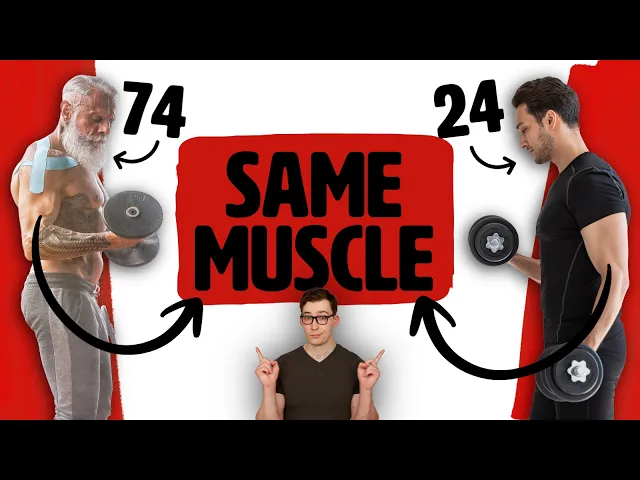
Individuals in their 70s who practiced lifelong strength training performed better on strength tests than recreationally active people 50 years younger than them.

Maintain strength training to preserve youthful muscle profile

Those who have been strength training for the last 50 years have a muscle type profile that is closer to that of young muscle.

Clarify strength measurement methods for accurate comparisons

Discrepancies between studies on master athletes' strength are likely due to the different ways strength is assessed, such as using a leg press versus a pull-up.

Adapt to muscle type changes with aging for better strength

As we age, our muscles tend to experience a shift from force-producing type 2 fibers to endurance-based type 1 fibers, reducing our force generation ability.

Preserve muscle health for lifelong strength

Your muscle cells are post-mitotic, meaning the same cells propelling you in childhood are the same ones sustaining you 50 years later.

Prioritize strength training to maintain muscle and strength with age

Focus on strength training for the best 'bang for your buck' in maintaining your muscle type profile, strength, and force as you age.

DESCARGA LA APLICACIÓN

Descubre la sabiduría de la longevidad

DESCARGA LA APLICACIÓN

Descubre la sabiduría de la longevidad

DESCARGA LA APLICACIÓN

Descubre la sabiduría de la longevidad