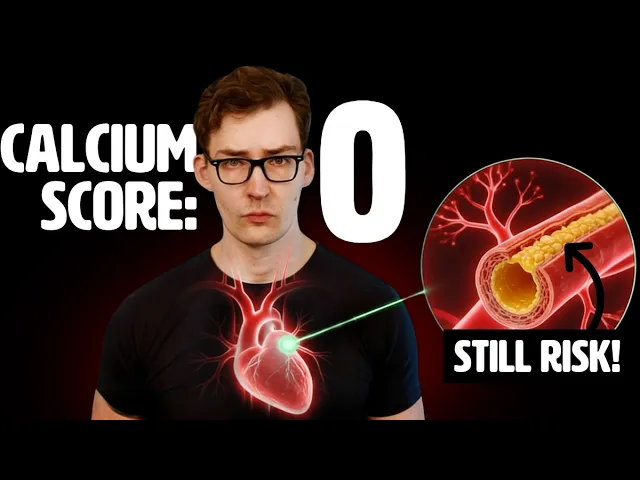
Don’t be Fooled by Coronary Artery Calcium score of 0…
Physionic
Jan 5, 2026
Episode description
JOIN THE PHYSIONIC INSIDERS [PREMIUM CONTENT]
Join the Physionic Insiders: https://bit.ly/PhysionicInsiders2
HEALTH AUTONOMY [COURSE]
Learn to Analyze & Apply Studies for Yourself: https://bit.ly/healthautonomy
JOIN THE COMMUNITY
Join my Community [It’s Free!]: https://bit.ly/PhysionicCommunity2
EMAIL LIST
1-2 Weekly Email of Value [It’s Free!]: http://bit.ly/2AXIzK6
HIRE ME FOR CONSULTING:
Consulting: https://bit.ly/3dmUl2H
Created with Biorender
0:00 - Introduction
1:10 - Understanding Coronary Artery Calcium
2:27 - A False Sense of Security
5:00 - Higher CAC... Better? Sometimes.
7:35 - A Better Test
9:38 - Think of it this way…
References [Funding/Conflicts of Interest are supplied in the free article available in the Free Physionic Community or in the email list - they don't fit in the description]
[Study 573] Onnis C, Virmani R, Kawai K, et al. Coronary artery calcification: current concepts and clinical implications. Circulation. 2024;149:251-266. doi:10.1161/CIRCULATIONAHA.123.065657.
[Study 574] Sama C, Abdelhaleem A, Velu D, et al. Non-calcified plaque in asymptomatic patients with zero coronary artery calcium score: A systematic review and meta-analysis. J Cardiovasc Comput Tomogr. 2024;18(1):43-49. doi:10.1016/j.jcct.2023.10.002
[Study 575] Williams MC, Kwiecinski J, Doris M, et al. Low-Attenuation Noncalcified Plaque on Coronary Computed Tomography Angiography Predicts Myocardial Infarction: Results From the Multicenter SCOT-HEART Trial (Scottish Computed Tomography of the HEART). Circulation. 2020;141(18):1452-1462. doi:10.1161/CIRCULATIONAHA.119.044720
[Study 576] Budoff MJ, McClelland RL, Nasir K, et al. Cardiovascular events with absent or minimal coronary calcification: the Multi-Ethnic Study of Atherosclerosis (MESA). Am Heart J. 2009;158(4):554-561. doi:10.1016/j.ahj.2009.08.007
[Study 577] Budoff MJ, Young R, Burke G, et al. Ten-year association of coronary artery calcium with atherosclerotic cardiovascular disease (ASCVD) events: the multi-ethnic study of atherosclerosis (MESA). Eur Heart J. 2018;39(25):2401-2408. doi:10.1093/eurheartj/ehy217
[Study 578] Bergström G, Persson M, Adiels M, et al. Prevalence of Subclinical Coronary Artery Atherosclerosis in the General Population. Circulation. 2021;144(12):916-929. doi:10.1161/CIRCULATIONAHA.121.055340
Please use the following link to submit your critique of my work: https://bit.ly/PhysionicCritique
#coronaryarterydisease #heartdisease #heartdiseaseprevention
Mindsip insights from this episode:
Evaluate health metrics alongside zero CAC score for accurate plaque assessment
A CAC score of zero is only truly comforting if your other health metrics are good; if you have many risk factors, a zero score may not accurately reflect your real plaque status.

Utilize CCTA to identify reversible soft plaque
The CCTA test is advantageous because it identifies soft plaque, which is generally considered more reversible than the hardened, calcified plaque.

Stabilize plaque with drugs to improve health despite increased CAC score
Certain molecules and drugs can stabilize dangerous plaque by accelerating its calcification, which is a net health benefit even though it causes the CAC score to shoot up.
Understand high CAC score as potential indicator of stabilized plaque
In some contexts, a high CAC score might be better than a low one because it can indicate that dangerous soft plaque has been stabilized into less risky, densely calcified plaque.
Understand zero CAC score does not eliminate cardiac risk
A coronary artery calcium (CAC) score of zero does not guarantee you are free from the risk of a major cardiac event like a heart attack or stroke.
Clarify CAC score by separating plaque volume and density
The CAC score can be misleading because it combines plaque volume (bad) with plaque density (potentially good), making the final number difficult to interpret without context.
Choose CCTA for accurate assessment of soft plaque risk
A CCTA (contrast coronary CT angiograph) is a superior test because it directly measures the dangerous soft plaque, not just the calcium that may or may not be present.
More from
Physionic


You also might be interested in

Too Much Histamine Is Wrecking Your Body — And Most Doctors Don't Know It

This Ancient Hack Reverses Aging In 72 Hours

The Potent Brain & Body Ketone Fuel You’ve Probably Never Heard Of: The Science Of R3HBG With Tecton’s Dr. Mike Chesne

How To Maintain Muscle On A GLP-1, Why Protein Stops Working As You Get Older, The Truth About Eating “Before Bedtime” & More! Solosode #502

Essentials: Tools for Hormone Optimization in Males | Dr. Kyle Gillett