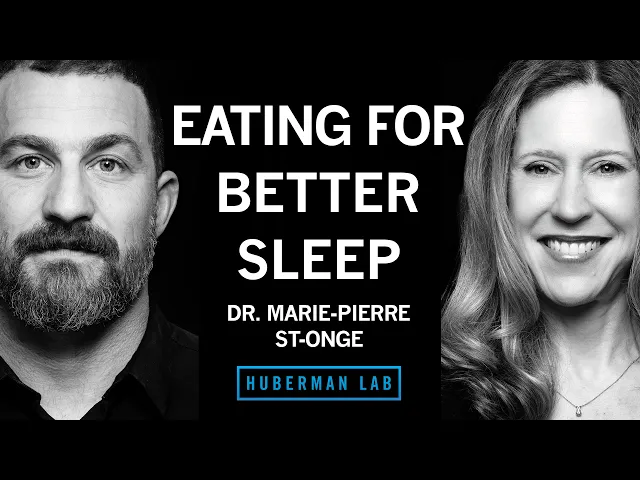
Eating for Better Sleep & Foods that Improve Metabolic Health | Dr. Marie-Pierre St-Onge
Andrew Huberman
Jun 8, 2026
Episode description
Dr. Marie-Pierre St-Onge, PhD, is a professor of nutritional medicine at Columbia University School of Medicine and an expert on the bidirectional relationship between nutrition and sleep. We discuss how even moderate sleep loss increases appetite, changes hunger-related hormones, and causes weight gain, even when calories are not increased. We also explain how meal timing and specific foods, like fiber, ginger, saturated fat, and various oils, affect sleep onset, sleep quality, and metabolism. Throughout the conversation, we discuss specific foods and diets that directly support weight loss, better sleep, and long-term cardiometabolic health.
Show notes: https://go.hubermanlab.com/zKdZ0ZY
Thank you to our sponsors
AG1: https://drinkag1.com/huberman
David: https://davidprotein.com/huberman
BetterHelp: https://betterhelp.com/huberman
Helix Sleep: https://helixsleep.com/huberman
Huberman Lab
Instagram: https://www.instagram.com/hubermanlab
Threads: https://www.threads.net/@hubermanlab
X: https://x.com/hubermanlab
Facebook: https://www.facebook.com/hubermanlab
TikTok: https://www.tiktok.com/@hubermanlab
LinkedIn: https://www.linkedin.com/in/andrew-huberman
Website: https://www.hubermanlab.com
Newsletter: https://www.hubermanlab.com/newsletter
Dr. Marie-Pierre St-Onge
Website: https://marie-pierrest-onge.com
Academic profile: https://www.ihn.cuimc.columbia.edu/profile/marie-pierre-st-onge-phd
Eat Better, Sleep Better (book): https://amzn.to/4uqgvq9
Publications: https://marie-pierrest-onge.com/httpswwwncbinlmnihgovmyncbimarie-pierrest-onge1bibliographypublic
X: https://x.com/MPStOngePhD
Bluesky: https://bsky.app/profile/m-pst-ongephd.bsky.social
LinkedIn: https://www.linkedin.com/in/marie-pierre-st-onge-a6423320
Timestamps
00:00:00 Marie-Pierre St-Onge
00:02:29 Sleep Loss & Appetite, Men vs Women
00:10:20 Sponsors: David & BetterHelp
00:12:39 Sleep Loss, Overeating & Cardiometabolic Health
00:21:56 Weight Gain & Sleep Loss, Tool: Informed Food Choices
00:27:59 Diet & Sleep, Insomnia; Tool: Mediterranean Diet, DASH Diet
00:33:25 Food Choices & Sleep Quality, Food Timing
00:39:33 Sponsor: AG1
00:40:52 Personal Circadian Clock, Shift Work; Naps; Running & Yoga
00:53:00 Snoring, Sleep Apnea & Testing
00:56:46 Kefir; Coffee Mannooligosaccharides & Weight Loss; Ginger; Fiber
01:09:49 Sponsor: Helix Sleep
01:11:23 Food Timing & Burning Fat, Tool: Early Meals
01:17:20 Medium-Chain Triglycerides (MCTs), Body Composition & Weight Loss
01:22:54 Tools: Eating for Sleep & Metabolism; Portion Size; Portfolio Diet
01:34:38 Corn Oil, Seed Oils & Processed Foods, Smoke Points
01:41:20 Industry-Sponsored Studies
01:50:41 Supplements, Whole Foods, Fiber
01:54:25 Zero-Cost Support, YouTube, Spotify & Apple Follow, Reviews & Feedback, Sponsors, Protocols Book, Social Media, Neural Network Newsletter
#hubermanlab #metabolichealth #health
Disclaimer & Disclosures: https://www.hubermanlab.com/disclaimer
Mindsip insights from this episode:
Aim for 6.5 to 7.8 hours of sleep for optimal aging
Recent research suggests the optimal sleep duration for most organs' aging is between 6.5 and 7.8 hours per night.

Eat last meal three hours before sleep for better rest
The researcher personally recommends eating your last meal at least three hours before going to bed to allow your body to cool down for sleep.
Replace dietary fats with MCT oil to boost weight loss
Replacing standard dietary fats like olive oil with medium-chain triglyceride (MCT) oil has been shown to increase calorie burn and lead to greater weight loss.
Balance sleep to regulate hunger hormones in men and women
In men, short sleep increases the hunger-triggering hormone ghrelin, whereas in women, it reduces the satiety hormone GLP-1.
Substitute snacks with corn chips to improve lipid profiles
In one industry-funded study, substituting snacks with corn chips fried in corn oil improved lipid profiles more than low-fat or high-saturated-fat snacks.
Limit sleep loss to protect metabolism
In a free-living study, reducing sleep by just 1.5 hours per night for six weeks increased insulin resistance and blood pressure.
Increase fiber intake to enhance deep sleep quality
Higher fiber intake is associated with more deep sleep, while higher saturated fat intake is linked to less deep sleep and simple sugars lead to more sleep arousals.
Maintain stable cortisol levels despite sleep loss
In a controlled lab study, five nights of severe sleep restriction to about four hours per night did not change participants' cortisol levels.
Avoid late meals to enhance fat burning
Eating meals later in the day, even when the food and total eating window are identical, leads to significantly less fat oxidation.
Boost calorie burn with ginger in warm water
A study found that consuming ginger powder dissolved in warm water significantly increased the thermic effect of food, meaning more calories were burned.
More from
Andrew Huberman
How to Improve Your Memory & Cognitive Function at Any Age | Dr. Alan Castel

Raising a Dog & Mastering Calm Assertive Energy | Cesar Millan
Essentials: Tools for Hormone Optimization in Males | Dr. Kyle Gillett

Movement Practice to Strengthen Your Mind-Body Connection | Ido Portal

Essentials: The Science of Eating for Health, Fat Loss & Lean Muscle | Dr. Layne Norton
You also might be interested in
Too Much Histamine Is Wrecking Your Body — And Most Doctors Don't Know It

This Ancient Hack Reverses Aging In 72 Hours

The Potent Brain & Body Ketone Fuel You’ve Probably Never Heard Of: The Science Of R3HBG With Tecton’s Dr. Mike Chesne

1 Year of Lutein: Reversing Arterial Plaque

How To Maintain Muscle On A GLP-1, Why Protein Stops Working As You Get Older, The Truth About Eating “Before Bedtime” & More! Solosode #502