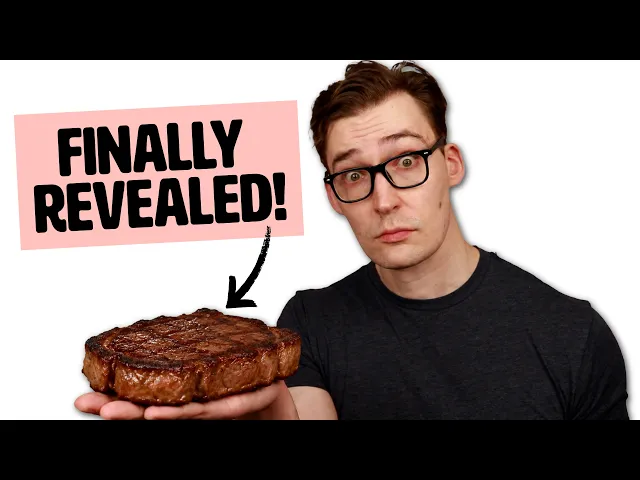
This New Protein Study just Changed how we Think about Protein!
Physionic
Jun 8, 2026
Episode description
JOIN THE PHYSIONIC INSIDERS [PREMIUM CONTENT]
Join the Physionic Insiders: https://bit.ly/PhysionicInsiders2
HEALTH AUTONOMY [COURSE]
Learn to Analyze & Apply Studies for Yourself: https://bit.ly/healthautonomy
JOIN THE COMMUNITY
Join my Community [It’s Free!]: https://bit.ly/PhysionicCommunity2
EMAIL LIST
1-2 Weekly Email of Value [It’s Free!]: http://bit.ly/2AXIzK6
HIRE ME FOR CONSULTING:
Consulting: https://bit.ly/3dmUl2H
Created with Biorender
0:00 - Introduction
0:25 - This is Old News, Dude…
3:04 - A Popular Amino Acid just got… Popular-er
4:28 - How do we use this?
References
[Study 803] Tsang AH, Heeley N, Alcaino C, Hwang E, Lam BY, Rahman T, et al. Cav3.1 is a neuronal leucine sensor that mediates satiety and weight loss in response to dietary protein. Cell Metab. 2026;38(5):876-890.e13. doi:10.1016/j.cmet.2026.03.017.
Funding/Conflicts: Public Funding: From the study, support included the Medical Research Council/MRC grants MC_UU_12012/5, MC_UU_12012/1, MC_UU_00014/6, MR/M501736/1, MR/S011552/1, and MC_UU_00014/5; Non-Profit Funding: From the study, support included Wellcome Trust grants 100574/Z/12/Z, 204845/Z/16/Z, and 208363/Z/17/Z, plus a British Society for Neuroendocrinology Summer Student award; Industry Funding: From the study, no industry funding source was reported, and the authors declared no competing interests.
[Study 804] Weigle DS, Breen PA, Matthys CC, Callahan HS, Meeuws KE, Burden VR, et al. A high-protein diet induces sustained reductions in appetite, ad libitum caloric intake, and body weight despite compensatory changes in diurnal plasma leptin and ghrelin concentrations. Am J Clin Nutr. 2005;82(1):41-48. doi:10.1093/ajcn.82.1.41.
Funding/Conflicts: Public Funding: From the study, the accessible indexing record lists NIH/NIDDK support, including grant DK35816; Non-Profit Funding: From the study, no non-profit funding source was found in the accessible record; Industry Funding: From the study, no industry funding source was found in the accessible record, and no conflict-of-interest statement was visible in the accessible record.
[Study 805] Lim JJ, Liu Y, Lu LW, Barnett D, Sequeira IR, Poppitt SD. Does a higher protein diet promote satiety and weight loss independent of carbohydrate content? An 8-week low-energy diet (LED) intervention. Nutrients. 2022;14(3):538. doi:10.3390/nu14030538.
Funding/Conflicts: Public Funding: From the study, the work was funded by the New Zealand Tertiary Education Commission through the Riddet Institute, a New Zealand Centre of Research Excellence, including a PhD scholarship for J.J.L.; Non-Profit Funding: From the study, no non-profit funding source was reported; Industry Funding: From the study, Cambridge Diet NZ and Nutratech Ltd. partially supported product costs for meal replacements and whey protein, and the authors declared no conflicts of interest.
[Study 806] Bolster DR, Rahn M, Kamil AG, Bristol LT, Goltz SR, Leidy HJ, et al. Consuming lower-protein nutrition bars with added leucine elicits postprandial changes in appetite sensations in healthy women. J Nutr. 2018;148(5):693-701. doi:10.1093/jn/nxy023.
Funding/Conflicts: Public Funding: From the study, no public funding source was reported; Non-Profit Funding: From the study, no non-profit funding source was reported; Industry Funding: From the study, the work was supported by PepsiCo R&D, and conflicts included DRB, MR, AGK, LTB, SRG, MBMT, MAN, EG, JW, and LSH being employees of PepsiCo or employees at the time the study took place, while HJL reported no conflicts of interest.
[Study 807] Veldhorst MA, Nieuwenhuizen AG, Hochstenbach-Waelen A, et al. Dose-dependent satiating effect of whey relative to casein or soy. Physiol Behav. 2009;96(4-5):675-682. doi:10.1016/j.physbeh.2009.01.004
Funding/Conflicts: Public Funding: From the study, no public funding source was reported; Non-Profit Funding: From the study, no non-profit funding source was reported; Industry Funding: From the study, no industry funding source was reported, and no conflict-of-interest statement was found in the accessible full-text record. The author affiliations included Maastricht University/NUTRIM and the Top Institute Food and Nutrition, but these were listed as affiliations rather than explicit funding sources.
Please use the following link to submit your critique: https://bit.ly/PhysionicCritique
Disclaimer: None of the information provided by this brand is a replacement for your physician's advice. This brand is information for the sake of knowledge and the options of choice it provides, not in any way a personalized prescription. Please consult your physician before making any health related changes.
Mindsip insights from this episode:
Leverage protein to reduce calorie consumption for fat loss
The primary way protein aids fat loss is by naturally reducing your calorie consumption, an effect most apparent when you don't actively restrict calories.
Leverage brain protein CAV3.1 to reduce food consumption
A functional protein in the brain called CAV3.1 is responsible for the reduction in food consumption seen after eating dietary protein.
Activate satiety signals with leucine from dietary protein
The amino acid leucine, found in dietary protein, directly binds to and activates the CAV3.1 protein on brain neurons, sending signals that you are full.
Choose leucine-rich protein to curb hunger
Even in low-protein meals, protein sources higher in the amino acid leucine led to significantly less hunger compared to other forms of protein.

Incorporate 25% protein intake to manage weight
Eating around 25% of your total food intake as protein can help you maintain or lose weight, particularly if you dislike counting calories.
More from
Physionic


You also might be interested in

90 Days of Full Carnivore: No Plants, No Fiber, Surprising Gut Results | Ben Azadi

Essentials: The Science of Eating for Health, Fat Loss & Lean Muscle | Dr. Layne Norton

Could Diet Reverse the Course of MS? Dr. Terry Wahls' Remarkable Recovery
I Drink Fat To Look Shredded (Lost 100lbs)
The Perfect Morning Routine for a Longer, Sharper Life | Dr. Mark Hyman