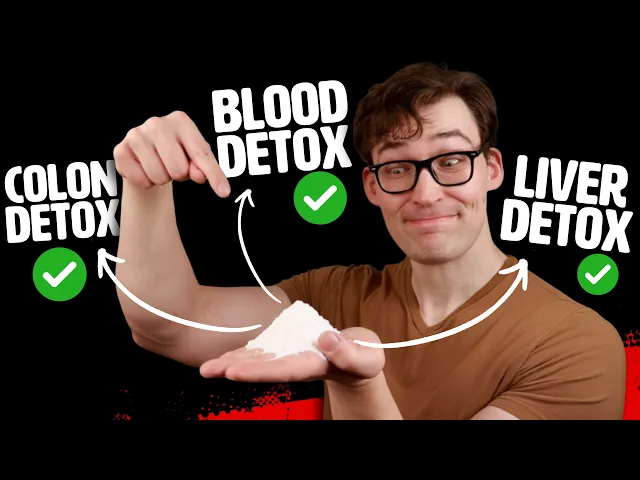
This Powder Cleanses the Liver, Colon, and Blood and I Use it Every Day
Physionic
Mar 2, 2026
Episode description
JOIN THE PHYSIONIC INSIDERS [PREMIUM CONTENT]
Join the Physionic Insiders: https://bit.ly/PhysionicInsiders2
HEALTH AUTONOMY [COURSE]
Learn to Analyze & Apply Studies for Yourself: https://bit.ly/healthautonomy
JOIN THE COMMUNITY
Join my Community [It’s Free!]: https://bit.ly/PhysionicCommunity2
EMAIL LIST
1-2 Weekly Email of Value [It’s Free!]: http://bit.ly/2AXIzK6
HIRE ME FOR CONSULTING:
Consulting: https://bit.ly/3dmUl2H
Created with Biorender
0:00 - Introduction
0:42 - The Problem is in the Blood
2:42 - A Hostile Take Over
5:23 - A Cleansing Powder
Resistant Starch on Visceral Fat and High Responders: https://youtu.be/0Er08-E2HnU?si=14vKZVxbkmiXRsTU
References
[Study 606] Ni Y, Qian L, Leal Siliceo S, et al. Resistant starch decreases intrahepatic triglycerides in patients with NAFLD via gut microbiome alterations. Cell Metab. 2023;35(9):1530-1547. doi:10.1016/j.cmet.2023.08.002
Funding/Conflict: The study reports support from the National Natural Science Foundation of China, Shanghai Municipal Key Clinical Specialty, Shanghai Research Center for Endocrine and Metabolic Diseases, the National Key Research and Development Program of China, Shanghai Jiao Tong University School of Medicine, Dalian Institute of Chemical Physics of the Chinese Academy of Sciences, and a Key Foundation; Non-Profit funding: support also came from Marie Sklodowska Curie Actions and the Horizon 2020 Innovative Training Networks program BestTreat; Industry funding: no industry funding was identified; Conflicts of interest: the authors declared no competing interests.
[Study 607] Long X, Wang H, Lu Y, et al. Interindividual variability in gut microbiome mediates the efficacy of resistant starch on MASLD. Cell Metab. 2025;37:2342-2361. doi:10.1016/j.cmet.2025.10.017
Funding/Conflict: Based on the available records, the study appears to have received public support including the National Natural Science Foundation of China, with at least grant 82103908 visible in indexed sources; Non-Profit funding: I could not verify any non-profit funding from the uploaded file; Industry funding: I could not verify any industry funding from the uploaded file; Conflicts of interest: the available journal snippet states that the authors declared no conflicts of interest. The uploaded PDF you sent only contains the citation page and not the acknowledgments or disclosure section, so the funding breakdown is only partially verifiable from what is available.
[Study 635] Lo EKK, Felicianna, Xu JH, Zhan Q, Zeng Z, El-Nezami H. The Emerging Role of Branched-Chain Amino Acids in Liver Diseases. Biomedicines. 2022;10(6):1444. Published 2022 Jun 18. doi:10.3390/biomedicines10061444
Funding/Conflict: This study was supported by the National Natural Science Foundation of China, grant No. 61972007; Non-Profit funding: no non-profit funding was reported; Industry funding: no industry funding was reported; Conflicts of interest: the authors declared no conflict of interest.
[Study 636] Mansoori S, Ho MY, Ng KK, Cheng KK. Branched-chain amino acid metabolism: Pathophysiological mechanism and therapeutic intervention in metabolic diseases. Obes Rev. 2025;26(2):e13856. doi:10.1111/obr.13856
Funding/Conflict: This study was supported by PolyU Project of Strategic Importance (P0036848), PolyU Project of RCMI (P0040979), the National Natural Science Foundation of China (81970675 and 92357305), the Research Grants Council Collaborative Research Fund (C5044-23G), the General Research Fund of the Hong Kong Research Grant Council (15101221), and the Shenzhen Municipal Science and Technology Innovation Commission (JCYJ20210324130202006); Non-Profit funding: no non-profit funding was identified in the available record; Industry funding: no industry funding was identified in the available record; Conflicts of interest: the authors declared no conflict of interest.
Please use the following link to submit your critique: https://bit.ly/PhysionicCritique
Disclaimer: None of the information provided by this brand is a replacement for your physician's advice. This brand is information for the sake of knowledge and the options of choice it provides, not in any way a personalized prescription. Please consult your physician before making any health related changes.
Mindsip insights from this episode:
Reduce BCAA production by supplementing with resistant starch
Supplementing with resistant starch leads to significant reductions in the colon's production of all three branched-chain amino acids.
Reduce blood BCAAs to lower non-alcoholic fatty liver disease risk
Higher levels of branched-chain amino acids (BCAAs) in your blood are associated with a greater risk and amount of non-alcoholic fatty liver disease (NAFLD).

Limit gut bacteria to reduce harmful BCAAs and fat storage
Particular bacteria in your gut can produce BCAAs, which contribute to blood BCAA levels and directly increase fat storage in the liver.

Reduce liver fat by 25% with resistant starch supplementation
After four months of supplementation, people using resistant starches experienced a notable reduction in their liver fat by about 25%.

Incorporate resistant starch powders like green banana and potato starch
You can get resistant starches from specific food powders like green banana powder, high-amylose maize, and potato starch.
Understand BCAA levels beyond dietary sources
High blood BCAAs are not primarily driven by dietary consumption but by a combination of impaired clearance by the body and production from the gut.

Consume 40 grams of resistant starch daily for health benefits
A daily dose of about 40 grams of resistant starch, often mixed in a shake, is a practical amount for consumption.
More from
Physionic


You also might be interested in

Too Much Histamine Is Wrecking Your Body — And Most Doctors Don't Know It

This Ancient Hack Reverses Aging In 72 Hours

The Potent Brain & Body Ketone Fuel You’ve Probably Never Heard Of: The Science Of R3HBG With Tecton’s Dr. Mike Chesne

How To Maintain Muscle On A GLP-1, Why Protein Stops Working As You Get Older, The Truth About Eating “Before Bedtime” & More! Solosode #502

Essentials: Tools for Hormone Optimization in Males | Dr. Kyle Gillett