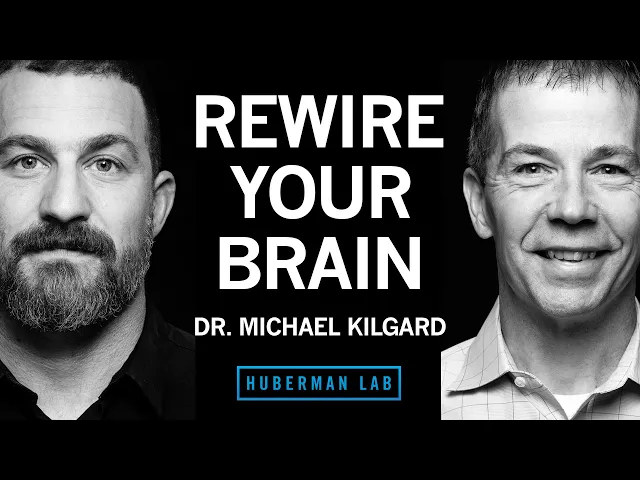
How to Rewire Your Brain & Learn Faster | Dr. Michael Kilgard
Andrew Huberman
Aug 11, 2025
Episode description
In this episode, my guest is Dr. Michael Kilgard, PhD, a professor of neuroscience at the University of Texas at Dallas and a leading expert on neuroplasticity and learning across the lifespan. We discuss the need for alertness, effortful focus, post-learning reflection and sleep to induce neuroplasticity, and how dopamine, acetylcholine, serotonin and norepinephrine are each involved. He explains the behavioral steps for neuroplasticity, as well as vagal nerve stimulation (VNS) and other therapies for tinnitus, stroke, depression, PTSD and paralysis. This episode ought to be of use to anyone interested in understanding the modern science of brain rewiring and learning to improve cognitive or motor skills or treat sensory or motor disorders.
Episode show notes: https://go.hubermanlab.com/0LbwBp4
*Thank you to our sponsors*
AG1: https://drinkag1.com/huberman
Eight Sleep: https://eightsleep.com/huberman
Wealthfront*: https://wealthfront.com/huberman
Carbon: https://joincarbon.com/huberman
Function: https://functionhealth.com/huberman
_*This experience may not be representative of the experience of other clients of Wealthfront, and there is no guarantee that all clients will have similar experiences. Cash Account is offered by Wealthfront Brokerage LLC, Member FINRA/SIPC. The Annual Percentage Yield (“APY”) on cash deposits as of December 27, 2024, is representative, subject to change, and requires no minimum. Funds in the Cash Account are swept to partner banks where they earn the variable APY. Promo terms and FDIC coverage conditions apply. Same-day withdrawal or instant payment transfers may be limited by destination institutions, daily transaction caps, and by participating entities such as Wells Fargo, the RTP® Network, and FedNow® Service. New Cash Account deposits are subject to a 2-4 day holding period before becoming available for transfer._
*Follow Huberman Lab*
Instagram: https://www.instagram.com/hubermanlab
Threads: https://www.threads.net/@hubermanlab
X: https://twitter.com/hubermanlab
Facebook: https://www.facebook.com/hubermanlab
TikTok: https://www.tiktok.com/@hubermanlab
LinkedIn: https://www.linkedin.com/in/andrew-huberman
Website: https://www.hubermanlab.com
Newsletter: https://www.hubermanlab.com/newsletter
*Dr. Michael Kilgard*
The University of Texas at Dallas academic profile: https://profiles.utdallas.edu/michael.kilgard
Lab website: https://personal.utdallas.edu/~kilgard
Texas Biomedical Device Center: https://txbdc.utdallas.edu/about/leadership
Google Scholar: https://scholar.google.com/citations?user=rXdJOKsAAAAJ&hl=en
LinkedIn: https://www.linkedin.com/in/michael-kilgard-9070a26
*Timestamps*
00:00:00 Michael Kilgard
00:03:24 Neuroplasticity
00:05:13 Child vs Adult Plasticity, Childhood Development & Learning
00:09:37 Sponsors: Eight Sleep & Wealthfront
00:12:41 Kids, Real vs Artificial Experiences & Balance, Video Games, Natural World
00:21:13 Social Media & Videos, Kids, Overstimulation & Development
00:33:42 Early Language Development, Passive vs Real Experiences, Kids & Adults
00:39:23 Sponsors: AG1 & Carbon
00:42:44 Learning & Plasticity Requirements; Focus, Friction, Rest & Reflection
00:52:24 Brain Connections, Complexity, Life Experiences & Plasticity
01:02:51 Learning, Reflection, Visualization, Testing
01:09:45 Experience Diversity & Time, Happiness, Life Appreciation
01:18:05 Sponsor: Function
01:19:53 Learning & Life Meaning
01:23:25 Neuromodulators, Brain Complexity, Synaptic Eligibility Trace & Learning
01:34:28 Synapses, Therapy for PTSD, Rewiring the Brain
01:39:01 Vagus Nerve Stimulation (VNS), Stroke, Spinal Cord Injury, Tinnitus, PTSD
01:47:33 Psychedelics, Neurostimulation, Importance of Timing
01:57:47 Electroconvulsive Therapy (ECT) & Major Depression
02:01:51 Psychedelics/SSRIs as Plasticity Tools, SSRIs & Bone Strength, Failed Clinical Trials
02:13:18 Can VNS Accelerate Learning?
02:16:01 VNS Surgery, Patient Use & Specificity, Closed-Loop Vagus Nerve Stimulation
02:18:18 Tinnitus Cause, Incidence & Self-Amplification; PTSD & Control
02:28:12 VNS for Tinnitus; Disease Complexity & Treatments, Lazy Eye
02:41:05 Complexity of Disease Treatments & Combination Therapies
02:48:50 Brain-Machine Interfaces, Information & Experiences; Closed-Loop Feedback; Resilience
02:59:09 Evolving Clinical Trials, Combination Treatments & Disease Complexity
03:05:21 Acknowledgements
03:07:04 Zero-Cost Support, YouTube, Spotify & Apple Follow & Reviews, Sponsors, YouTube Feedback, Protocols Book, Social Media, Neural Network Newsletter
Disclaimer & Disclosures: https://www.hubermanlab.com/disclaimer
Mindsip insights from this episode:
Understand neuromodulators' complex roles beyond simple labels
It is an oversimplification to label dopamine as the 'reward' molecule or serotonin as the 'mood' molecule, as they likely work together in a complex cocktail to enable plasticity.

Choose real experiences over artificial manipulation
Experiences like video games can be detrimental because they lack the rich, unpredictable statistics of the natural world and can be designed to manipulate you.
Redirect focus away from tinnitus to alleviate symptoms
Worrying about and paying attention to the ringing sound of tinnitus actually strengthens the neural circuits responsible for it, making the condition worse.
Utilize vagus nerve stimulation to enhance targeted learning
A vagus nerve stimulator can trick the brain into releasing a cocktail of three key neuromodulators by sending a signal that mimics a major bodily event, opening a brief window for targeted learning.
Balance reading with real-world experiences to foster original ideas
Citing Ralph Waldo Emerson, the speaker suggests that over-reliance on books can prevent you from forming your own ideas and having your own real-world adventures.
Limit social media use to protect mental health
Rapidly scrolling through novel videos may over-activate the brain's neuromodulator systems, and the long-term consequences of this overstimulation are unknown but could be linked to depression and anxiety.
Engage actively for effective language learning in infants
A baby's brain does not effectively learn sounds from another language when exposed passively through a screen; neuroplasticity requires active interaction.
Visualize past skills to enhance performance
Mental rehearsal is most effective for reinforcing skills you have already performed in the real world, but it is not a good way to learn entirely new things.
Engage focus and friction for meaningful brain change
Meaningful and adaptive brain change requires not just focus but also an element of 'friction,' or self-generated work, to make the experience enriching.
Recognize vagus stimulation's limits on learning enhancement
While vagus nerve stimulation can help people recover from deficits like a stroke, experiments show it does not significantly enhance learning in already healthy, high-functioning individuals.

More from
Andrew Huberman
How to Improve Your Memory & Cognitive Function at Any Age | Dr. Alan Castel

Raising a Dog & Mastering Calm Assertive Energy | Cesar Millan

Essentials: Tools for Hormone Optimization in Males | Dr. Kyle Gillett

Movement Practice to Strengthen Your Mind-Body Connection | Ido Portal

Essentials: The Science of Eating for Health, Fat Loss & Lean Muscle | Dr. Layne Norton
You also might be interested in

Jordan Harbinger: Fight-or-Flight, Two Kidnappings, and the Wallet Ruining Your Spine

How Brain Inflammation Drives Depression, Alzheimer's, and Parkinson's

Danny McBride on Leaving Hollywood, the Collapse of Comedy & Doomscrolling’s Impact
Your Nervous System Controls Your Gut, Hormones, and Weight — Here's How to Fix It
I Tried EVERY Legal Focus Drug, Here’s What Actually Works