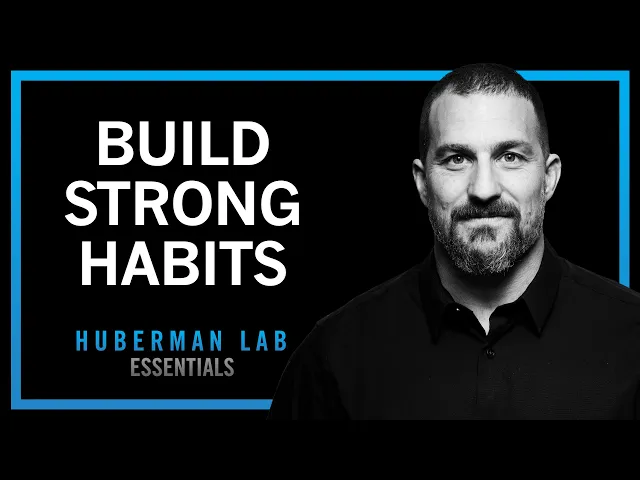
The Science of Making & Breaking Habits | Huberman Lab Essentials
Andrew Huberman
Dec 4, 2025
Episode description
In this Huberman Lab Essentials episode, I explain how to create lasting habits and break unwanted ones.I explain two habit-building systems: one aligned with daily rhythms and another based on a 21-day cycle of forming and reinforcing habits. I also discuss why habit formation differs between individuals and how certain "linchpin" habits can make other behaviors easier to adopt. Finally, I share practical tools—including visualization, task bracketing, and methods for rewiring bad habits—to support lasting behavioral change.Show notes: https://go.hubermanlab.com/Y9DJfJVHuberman Lab Essentials are short episodes focused on essential science and protocol takeaways from past full-length Huberman Lab episodes. Watch the full-length episode: https://youtu.be/Wcs2PFz5q6gWatch more Huberman Lab Essentials: https://youtube.com/playlist?list=PLPNW_gerXa4OGNy1yE-W9IX-tPu-tJa7SFollow Huberman LabInstagram: https://www.instagram.com/hubermanlab Threads: https://www.threads.net/@hubermanlabX: https://twitter.com/hubermanlab Facebook: https://www.facebook.com/hubermanlab TikTok: https://www.tiktok.com/@hubermanlab LinkedIn: https://www.linkedin.com/in/andrew-hubermanWebsite: https://www.hubermanlab.com Newsletter: https://www.hubermanlab.com/newsletterTimestamps00:00:00 Habits00:00:43 What are Habits?, Neuroplasticity00:01:15 Goal-Based vs Identity-Based Habits00:02:33 How Long Does It Take to Form a Habit?; Limbic Friction00:05:31 Tool: Linchpin Habits00:07:23 Habit Strength, Context Dependence & Limbic Friction00:09:13 How We Form Habits, Tool: Review Procedural Steps00:11:21 Tool: Task Bracketing00:15:02 Should You Schedule Habits?; Phase-Based Habit Plan00:17:00 Phase 1 (Morning) & Challenging Habits00:18:23 Phase 2 (Afternoon), Relaxation; Mellow Habits 00:21:46 Phase 3 (Evening), Enhancing Sleep & Habit Consolidation00:25:00 Habit Flexibility & Daily Timing00:27:33 Tool: 21-Day Habit Program; Habit Missteps00:32:47 Tool: How to Break Habits & Replacement Behaviors00:35:30 Recap#HubermanLab #Science #HabitsDisclaimer & Disclosures: https://www.hubermanlab.com/disclaimer
Mindsip insights from this episode:
Mentally rehearse procedural steps to establish new habits
Just once, mentally walking through the procedural steps of a new habit can significantly increase the likelihood of performing it regularly.

Replace bad habits with positive actions immediately
To break a bad habit, perform a positive and easy replacement habit immediately after the bad one occurs to rewrite the neural script.
Overcome limbic friction to establish habits
The speaker coins the term 'limbic friction' to describe the effort required to overcome states of anxiety or fatigue to perform a habit.
Understand habit formation timeline of 18 to 254 days
A 2010 study by Lally found that forming the same habit can take anywhere from 18 to 254 days, depending on the individual.
Structure your day into three phases for effective habit formation
Structure your day into three phases for habit formation: Phase 1 (0-8 hours awake) for hard habits, Phase 2 (9-15 hours) for easier habits, and Phase 3 (16-24 hours) for recovery.
Vary timing to strengthen habits
Once a habit becomes reflexive, moving it around to different times of the day can strengthen it by making it truly context-independent.
Implement 21-day habit system for consistent growth
For 21 days, list six new habits and aim to complete only four or five each day, focusing on the habit of performing habits rather than perfection.
Anchor habits to biological state for effectiveness
It is more effective to anchor habits to your biological state during certain phases of the day rather than to a specific clock time.
Leverage enjoyable linchpin habits to simplify difficult routines
Linchpin habits are enjoyable activities that you already do, which make other, harder habits easier to execute.
Leverage task brackets to automate habits
A brain region called the dorsolateral striatum becomes active at the beginning and end of a habit, creating a 'task bracket' that makes it automatic.
More from
Andrew Huberman
How to Improve Your Memory & Cognitive Function at Any Age | Dr. Alan Castel

Raising a Dog & Mastering Calm Assertive Energy | Cesar Millan

Essentials: Tools for Hormone Optimization in Males | Dr. Kyle Gillett

Movement Practice to Strengthen Your Mind-Body Connection | Ido Portal

Essentials: The Science of Eating for Health, Fat Loss & Lean Muscle | Dr. Layne Norton
You also might be interested in

Jordan Harbinger: Fight-or-Flight, Two Kidnappings, and the Wallet Ruining Your Spine

How Brain Inflammation Drives Depression, Alzheimer's, and Parkinson's

Danny McBride on Leaving Hollywood, the Collapse of Comedy & Doomscrolling’s Impact
Your Nervous System Controls Your Gut, Hormones, and Weight — Here's How to Fix It
I Tried EVERY Legal Focus Drug, Here’s What Actually Works