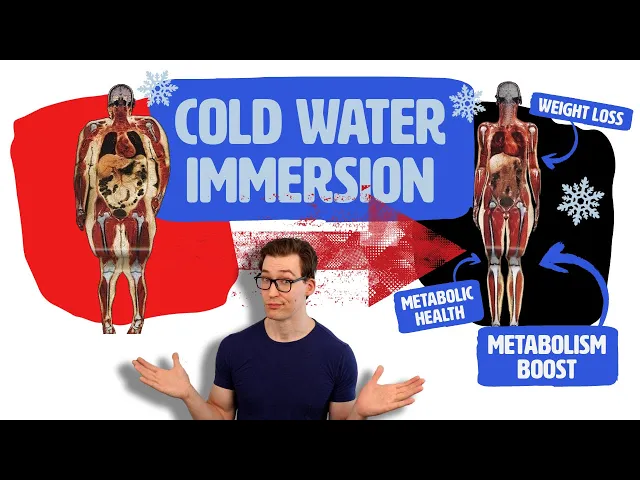
Cold Immersion: Redefining Metabolism
Physionic
Dec 16, 2024
Episode description
*JOIN THE PHYSIONIC INSIDERS [PREMIUM CONTENT]*
Join the Physionic Insiders: https://bit.ly/PhysionicInsiders2
*HEALTH AUTONOMY [COURSE]*
Learn to Analyze & Apply Studies for Yourself: https://bit.ly/healthautonomy
*JOIN THE COMMUNITY*
Join my Community [It’s Free!]: https://bit.ly/PhysionicCommunity2
*EMAIL LIST*
1-2 Weekly Email of Value [It’s Free!]: http://bit.ly/2AXIzK6
*HIRE ME FOR CONSULTING:*
Consulting: https://bit.ly/3dmUl2H
Created with Biorender
0:00 - Introduction
0:27 - Mechanisms
1:53 - Study Background
2:30 - Cold Immersion Results
5:57 - Take-Aways
References
[Study 370] Søberg S, Löfgren J, Philipsen FE, et al. Altered brown fat thermoregulation and enhanced cold-induced thermogenesis in young, healthy, winter-swimming men. Cell Rep Med. 2021;2(10):100408. Published 2021 Oct 11. doi:10.1016/j.xcrm.2021.100408
Funding/Conflicts: Mixed [Industry: Novo Nordisk / Public: European Research Council] / Potential Conflicts of Interest: Some researchers are consultants for Industry [Embark BioTech and Novo Nordisk]
********CRITIQUES, RULES, AND NOTES********
Be aware of the following rules before posting comments:
- Please do not post summaries of the video in the comments - it damages retention on the video and YouTube is less likely to promote it (these videos cost me a lot of money to produce).
Critiques of my work are welcome! Please be aware of the following notes & rules before submitting critique:
Be mindful that this content is not all encompassing on the subject at hand and is self-limited for brevity to reach a wider audience. Also, be aware that I receive hundreds of YouTube comments per day, so the only way your critique can be considered is if you follow the steps outlined below. Finally, YouTube auto-deletes links, so I do not see most comments with links attached.
RULES:
If your comment is rude, you will be banned.
If your comment is not about the studies/topics at hand (i.e. extending to other outcomes not discussed) or offers critique with no scientific basis, it is unlikely to receive a response.
If you can follow these rules, I will try to address your critique and if there is merit, I will add an AMENDMENT to the content in question and pin it so everyone can see it (thank you!).
Please use the following link to submit your critique: https://bit.ly/PhysionicCritique
Disclaimer: None of the information provided by this brand is a replacement for your physician's advice. This brand is information for the sake of knowledge and the options of choice it provides, not in any way a personalized prescription. Please consult your physician before making any health related changes.
#coldwaterimmersion #coldwatertherapy #icebathbenefits
Mindsip insights from this episode:
Leverage inefficient brown fat to enhance fat loss
Brown fat cells are energetically inefficient, which is beneficial for fat loss as they waste energy and need to pull more fat molecules from white fat stores.

Question study's findings on brown fat metabolic increases
The speaker is skeptical about the study's findings, noting that other research has shown metabolic increases from brown fat to be up to 50 times smaller.
Boost cold metabolism through increased muscle activity
The massive metabolic increase from cold exposure is not solely explained by brown fat; evidence suggests increased muscle activity is also a significant contributor.
Achieve a 1000-calorie metabolic boost through cold exposure
In one study, cold exposure gave a control group a nearly 500-calorie metabolic boost, while experienced winter swimmers received a nearly 1000-calorie boost.
Enhance insulin sensitivity through winter swimming
Experienced winter swimmers clear blood sugar from the body more effectively than a control group, indicating improved insulin sensitivity.
Increase brown fat to reduce cardiometabolic disease risk
An inverse relationship exists between the amount of brown adipose tissue in the body and the prevalence of cardiometabolic disease.
More from
Physionic


You also might be interested in
Too Much Histamine Is Wrecking Your Body — And Most Doctors Don't Know It

This Ancient Hack Reverses Aging In 72 Hours

The Potent Brain & Body Ketone Fuel You’ve Probably Never Heard Of: The Science Of R3HBG With Tecton’s Dr. Mike Chesne

How To Maintain Muscle On A GLP-1, Why Protein Stops Working As You Get Older, The Truth About Eating “Before Bedtime” & More! Solosode #502
Essentials: Tools for Hormone Optimization in Males | Dr. Kyle Gillett