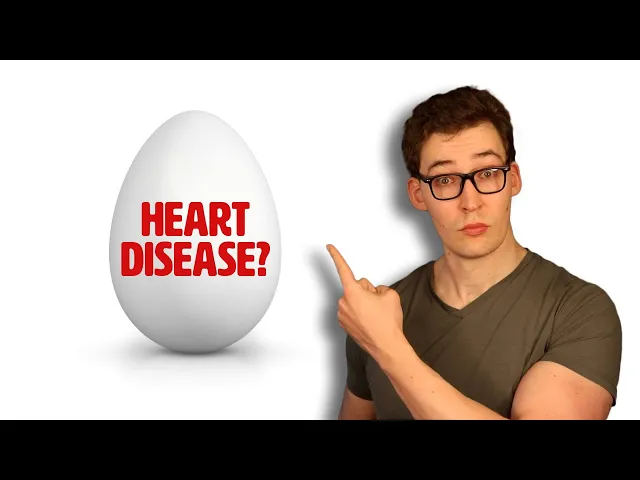
Do eggs cause heart disease?
Physionic
Apr 8, 2024
Episode description
*JOIN THE PHYSIONIC INSIDERS [PREMIUM CONTENT]*
Join the Physionic Insiders: https://bit.ly/PhysionicInsiders2
*HEALTH AUTONOMY [COURSE]*
Learn to Analyze & Apply Studies for Yourself: https://bit.ly/healthautonomy
*JOIN THE COMMUNITY*
Join my Community [It’s Free!]: https://bit.ly/PhysionicCommunity2
*EMAIL LIST*
1-2 Weekly Email of Value [It’s Free!]: http://bit.ly/2AXIzK6
*HIRE ME FOR CONSULTING:*
Consulting: https://bit.ly/3dmUl2H
Created with Biorender
References (Copy & Paste DOI into Search Engine)
[1] doi:10.1016/j.amjmed.2020.05.046
[2] doi:10.1007/s00394-020-02345-7
[3] doi:10.1007/s11883-023-01109-y
[4] doi:10.1093/nutrit/nuac002
[5] doi:10.3390/nu12071995
********CRITIQUES, RULES, AND NOTES********
Be aware of the following rules before posting comments:
- Please do not post summaries of the video in the comments - it damages retention on the video and YouTube is less likely to promote it (these videos cost me a lot of money to produce).
Critiques of my work are welcome! Please be aware of the following notes & rules before submitting critique:
Be mindful that this content is not all encompassing on the subject at hand and is self-limited for brevity to reach a wider audience. Also, be aware that I receive hundreds of YouTube comments per day, so the only way your critique can be considered is if you follow the steps outlined below. Finally, YouTube auto-deletes links, so I do not see most comments with links attached.
RULES:
If your comment is rude, you will be banned.
If your comment is not about the studies/topics at hand (i.e. extending to other outcomes not discussed) or offers critique with no scientific basis, it is unlikely to receive a response.
If you can follow these rules, I will try to address your critique and if there is merit, I will add an AMENDMENT to the content in question and pin it so everyone can see it (thank you!).
Please use the following link to submit your critique: https://bit.ly/PhysionicCritique
Disclaimer: None of the information provided by this brand is a replacement for your physician's advice. This brand is information for the sake of knowledge and the options of choice it provides, not in any way a personalized prescription. Please consult your physician before making any health related changes.
Mindsip insights from this episode:
Examine egg consumption's link to cardiovascular disease risk
A systematic review with multiple researchers funded by the Egg Board was the source that highlighted studies indicating eggs are a cardiovascular disease risk.
Evaluate egg consumption risk for individuals with diabetes
The increased heart failure risk from eggs appears to be driven primarily by individuals with diabetes, while being non-existent for women and neutral for men.

Limit egg consumption to reduce heart failure risk
While overall cardiovascular disease risk appears neutral, data shows a dramatic upward trend in heart failure risk with greater egg consumption.
Examine cholesterol adjustments to uncover egg consumption risks
Paradoxically, studies that statistically adjusted for high blood cholesterol showed increased mortality with egg consumption, while unadjusted data showed no relationship.
Incorporate eggs to lower cardiovascular disease risk in Asian populations
Across multiple contradictory analyses, all studies looking at people in Asia indicated only a reduced risk of cardiovascular disease from eating eggs.
Monitor egg choline intake to manage TMAO and cardiovascular risk
Choline in eggs can be converted by the gut microbiome into a molecule called TMAO, which is also linked to cardiovascular disease.
More from
Physionic


You also might be interested in
Too Much Histamine Is Wrecking Your Body — And Most Doctors Don't Know It

This Ancient Hack Reverses Aging In 72 Hours

The Potent Brain & Body Ketone Fuel You’ve Probably Never Heard Of: The Science Of R3HBG With Tecton’s Dr. Mike Chesne

How To Maintain Muscle On A GLP-1, Why Protein Stops Working As You Get Older, The Truth About Eating “Before Bedtime” & More! Solosode #502
Essentials: Tools for Hormone Optimization in Males | Dr. Kyle Gillett