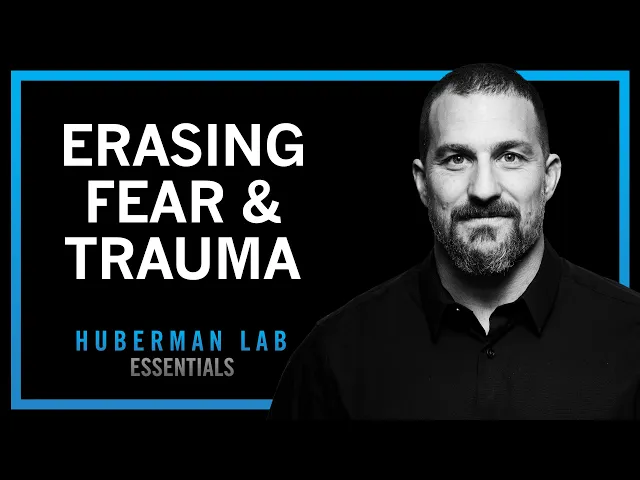
Erasing Fears & Traumas Using Modern Neuroscience | Huberman Lab Essentials
Andrew Huberman
Nov 6, 2025
Episode description
In this Huberman Lab Essentials episode, I explore the neuroscience of fear and trauma and how to effectively process and eliminate traumatic responses.
I explain why successful fear treatment requires both extinction of the old fearful response and replacement with a new positive association—not just cognitive reframing. I also explain how the threat reflex activates specific circuits connecting the amygdala, prefrontal cortex, and dopamine systems, and why detailed recounting of traumatic events progressively reduces their physiological impact. Finally, I review evidence-based approaches, including prolonged exposure therapy and cognitive behavioral therapy, discuss how five minutes per day of deliberate stress through cyclic hyperventilation can rewire fear responses, explain the critical role of social connection in activating neural pathways that reduce trauma, and share supplementation options for managing anxiety.
Episode show notes: https://go.hubermanlab.com/WeEXeyX
Huberman Lab Essentials are short episodes focused on essential science and protocol takeaways from past full-length Huberman Lab episodes. Watch the full-length episode: https://youtu.be/31wjVhCcI5Y
Watch more Huberman Lab Essentials episodes: https://youtube.com/playlist?list=PLPNW_gerXa4OGNy1yE-W9IX-tPu-tJa7S
*Follow Huberman Lab*
Instagram: https://www.instagram.com/hubermanlab
Threads: https://www.threads.net/@hubermanlab
X: https://twitter.com/hubermanlab
Facebook: https://www.facebook.com/hubermanlab
TikTok: https://www.tiktok.com/@hubermanlab
LinkedIn: https://www.linkedin.com/in/andrew-huberman
Website: https://www.hubermanlab.com
Newsletter: https://www.hubermanlab.com/newsletter
*Timestamps*
00:00:00 Introducing Fear & Trauma
00:00:17 What is Fear?
00:01:03 Autonomic Arousal: "Alertness" vs. "Calmness"
00:02:05 Fear vs. Stress & Anxiety
00:07:51 "The Threat Reflex": Neural Circuits for Fear
00:17:49 Cognitive (Narrative) Therapies for Fear
00:23:34 PTSD Treatments: Ketamine, MDMA, Oxytocin
00:28:30 Deliberate Brief Stress Can Erase Fears & Trauma
00:31:10 Nutrition, Sleep, & Other General Support Erasing Fear & Trauma
00:33:38 Recap
Disclaimer & Disclosures: https://www.hubermanlab.com/disclaimer
Mindsip insights from this episode:
Take high-dose inositol to reduce anxiety symptoms
Taking 18 grams of inositol daily for a month has been shown to decrease anxiety symptoms with a potency on par with many prescription antidepressants.

Utilize detailed retelling to reduce trauma response
A detailed recounting of traumatic events is essential in therapy, as the physiological anxiety response progressively diminishes with each retelling.
Leverage motivation to overwrite fearful memories
The brain's threat center, the amygdala, has a direct pathway to the dopamine system, which is why you can leverage motivation and reward to overwrite fearful memories.
Replace fear with positive experiences to overcome it
To overcome fear, you can't simply eliminate it; you must actively replace the fearful memory with a new, positive event or narrative.
Negotiate fear's meaning to shape your response
While the physical feeling of fear is a generic, non-negotiable reflex, your prefrontal cortex allows you to negotiate what that feeling means and how you will respond.
Experience unique brain state with MDMA's dual dopamine and serotonin boost
MDMA is unique because it causes large, simultaneous increases in both dopamine (motivation) and serotonin (contentment), a chemical state not normally experienced.
Utilize saffron to significantly reduce anxiety
Multiple human studies show that a 30mg dose of orally ingested saffron is a reliable dose for significantly reducing anxiety.
Utilize ketamine-assisted therapy to address trauma and depression
Ketamine-assisted psychotherapy appears to be especially beneficial for individuals whose trauma or fear is coupled with depressive symptoms.
Utilize short stress bouts to enhance resilience
Deliberately inducing short, five-minute bouts of stress daily through protocols like cyclic hyperventilation can help you recalibrate your stress response system.
Time anti-anxiety supplements strategically before therapy sessions
You should avoid taking anxiety-reducing supplements like saffron or inositol before a therapy session where the goal is to amplify and process a traumatic memory.

More from
Andrew Huberman
How to Improve Your Memory & Cognitive Function at Any Age | Dr. Alan Castel

Raising a Dog & Mastering Calm Assertive Energy | Cesar Millan

Essentials: Tools for Hormone Optimization in Males | Dr. Kyle Gillett

Movement Practice to Strengthen Your Mind-Body Connection | Ido Portal

Essentials: The Science of Eating for Health, Fat Loss & Lean Muscle | Dr. Layne Norton
You also might be interested in

Jordan Harbinger: Fight-or-Flight, Two Kidnappings, and the Wallet Ruining Your Spine

How Brain Inflammation Drives Depression, Alzheimer's, and Parkinson's

Danny McBride on Leaving Hollywood, the Collapse of Comedy & Doomscrolling’s Impact
Your Nervous System Controls Your Gut, Hormones, and Weight — Here's How to Fix It
I Tried EVERY Legal Focus Drug, Here’s What Actually Works