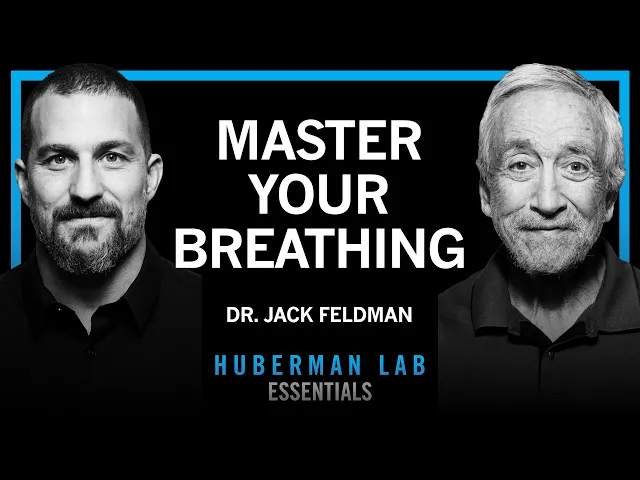
Essentials: Breathing for Mental & Physical Health & Performance | Dr. Jack Feldman
Andrew Huberman
Nov 13, 2025
Episode description
In this Huberman Lab Essentials episode, my guest is Dr. Jack Feldman, PhD, a Distinguished Professor of Neurobiology at the University of California, Los Angeles, and a leading expert in the science of breathing.We explain the mechanics of breathing and the neural circuits that generate and regulate our breathing rhythm. We also discuss how breathing patterns profoundly influence mental states, including their role in reducing anxiety and enhancing emotional resilience. Dr. Feldman also shares practical tools, such as box breathing for daily performance and magnesium L-threonate supplementation to support cognitive health and longevity.Episode show notes: https://go.hubermanlab.com/11vofKYHuberman Lab Essentials are short episodes focused on essential science and protocol takeaways from past full-length Huberman Lab episodes. Watch the full-length episode: https://youtu.be/GLgKkG44MGoWatch more Huberman Lab Essentials episodes: https://youtube.com/playlist?list=PLPNW_gerXa4OGNy1yE-W9IX-tPu-tJa7SFollow Huberman LabInstagram: https://www.instagram.com/hubermanlab Threads: https://www.threads.net/@hubermanlabX: https://twitter.com/hubermanlab Facebook: https://www.facebook.com/hubermanlab TikTok: https://www.tiktok.com/@hubermanlab LinkedIn: https://www.linkedin.com/in/andrew-hubermanWebsite: https://www.hubermanlab.com Newsletter: https://www.hubermanlab.com/newsletterDr. Jack FeldmanUCLA academic profile: https://bioscience.ucla.edu/people/jack-feldmanGoogle Scholar: https://scholar.google.com/citations?user=7VU42UMAAAAJ&hl=enWikipedia: https://en.wikipedia.org/wiki/Jack_L._FeldmanX: https://x.com/prebotzingerInstagram: https://www.instagram.com/jacklfeldmanTimestamps00:00:00 Jack Feldman00:00:23 Breathing Mechanics, Diaphragm; Pre-Bötzinger Complex & Breath Initiation00:03:25 Nose vs Mouth Breathing00:04:23 Active Expiration & Brain; Retrotrapezoid Nucleus00:07:32 Diaphragm & Evolution; Lung Surface Area & Alveoli, Oxygen Exchange00:11:56 Diaphragmatic vs Non-Diaphragmatic Breathing00:13:23 Physiological Sighs: Frequency & Function; Polio & Ventilators 00:17:21 Drug Overdose, Death & Gasps 00:19:06 Meditation, Slow Breathing & Fear Conditioning Study00:22:57 Mechanistic Science in Breathwork Validation; Breath Practice & Reduced Fear00:24:50 Breathing & Emotional/Cognitive State, Olfaction, Vagus Nerve00:27:13 Carbon Dioxide, Hyperventilation & Anxiety, Emotion00:29:27 Breathing & Autonomic Processes Coordination; Depression & Breath Practices00:32:44 Tool: Breathwork Practices, Box Breathing, Tummo, Wim Hof00:34:47 Magnesium L-Threonate & Cognitive Enhancement; Compound Refinement00:40:29 Clinical Trial, Magnesium L-Threonate & Cognitive Improvements; Dose, Sleep00:44:28 Acknowledgements#HubermanLab #HubermanLabPodcast #ScienceDisclaimer & Disclosures: https://www.hubermanlab.com/disclaimer
Mindsip insights from this episode:
Sigh every five minutes to maintain lung health
We automatically sigh about every five minutes to reinflate tiny, collapsed air sacs in the lungs, which is essential for maintaining lung health and function.

Question the benefits of diaphragmatic breathing for emotional health
A leading researcher is agnostic about the specific health benefits of diaphragmatic (belly) breathing, suggesting the effects of breathwork on emotion stem from other mechanisms.

Utilize breathwork to disrupt depression circuits
Consistent breathwork practice may alleviate depression by repeatedly disrupting the strong, looping neural circuits responsible for the condition, gradually weakening them over time.
Practice slow breathing to diminish fear response
In a recent study, mice that practiced slow breathing for 30 minutes daily showed a significantly reduced fear response, comparable to a major manipulation of the brain's fear center.
Reverse cognitive decline with magnesium threonate
A human study on subjects with mild cognitive impairment found that taking magnesium threonate for three months reversed their 'cognitive age' by an average of eight years.

Evolve diaphragm to support large brain development in mammals
The evolution of the diaphragm was a key step that enabled the development of large, oxygen-demanding brains in mammals.

Choose magnesium threonate for optimal brain health
Magnesium threonate was specifically developed to be more effective at crossing the gut and blood-brain barriers than other common forms of magnesium.
Influence emotional state through breathing techniques
Breathing influences your emotional state through multiple pathways, including rhythmic signals from the olfactory bulb and mechanical feedback from the lungs via the vagus nerve.
More from
Andrew Huberman
How to Improve Your Memory & Cognitive Function at Any Age | Dr. Alan Castel

Raising a Dog & Mastering Calm Assertive Energy | Cesar Millan

Essentials: Tools for Hormone Optimization in Males | Dr. Kyle Gillett

Movement Practice to Strengthen Your Mind-Body Connection | Ido Portal

Essentials: The Science of Eating for Health, Fat Loss & Lean Muscle | Dr. Layne Norton
You also might be interested in

Jordan Harbinger: Fight-or-Flight, Two Kidnappings, and the Wallet Ruining Your Spine
How Brain Inflammation Drives Depression, Alzheimer's, and Parkinson's

Danny McBride on Leaving Hollywood, the Collapse of Comedy & Doomscrolling’s Impact
Your Nervous System Controls Your Gut, Hormones, and Weight — Here's How to Fix It

I Tried EVERY Legal Focus Drug, Here’s What Actually Works