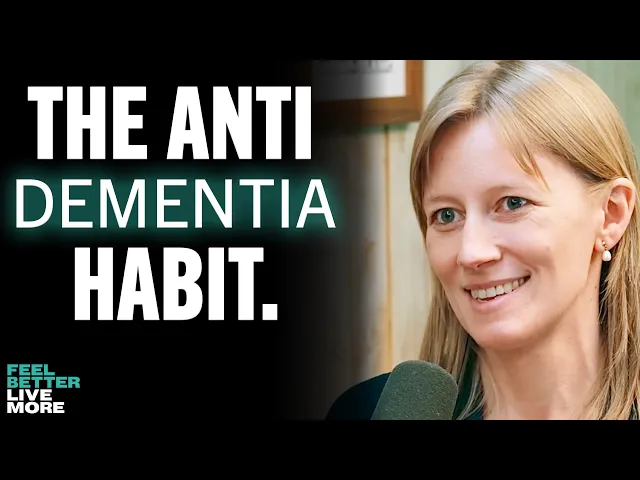
The Forgotten Habit That Lowers Dementia, Depression & Aging | Daisy Fancourt
Rangan Chatterjee
May 6, 2026
Episode description
Fill out our audience survey via https://drchatterjee.com/survey
This episode is brought to you by:
AG1: Get FREE AG1 Flavour Sampler, AGZ Sampler, Vitamin D3+K2 and Welcome Kit with your first AG1 subscription (worth $87, US only) https://bit.ly/43FwxQl
Most of us know that nutrition, movement and sleep are key pillars of health. But what if I told you that creativity belongs in the same conversation – and the science to prove it has been mounting up for decades?
Professor Daisy Fancourt, one of the world’s leading health researchers, has uncovered a wealth of evidence linking engagement with the arts to improved mental and physical health. It’s all collected in her wonderful book, Art Cure, and I only wish it had existed as required reading when I was a medical student.
Daisy agrees it’s been a ‘bizarrely well-kept secret’. We think of creative pursuits – music, theatre, dancing, arts and crafts – as ‘nice to haves’ but not necessary parts of life. But she believes a public awareness shift is on the horizon. Just as we’ve come to understand that exercise is an essential component of health, so too will we realise that ‘art as medicine’ is a scientific fact – one to be prescribed not ignored.
It’s quite the promise – and a really exciting one to consider. Because for most of us, the arts represent enjoyment. So this health advice could be the easiest and most pleasurable you’ve ever followed! During this conversation Daisy and I discuss what engaging with the arts really means, and why it differs from non-creative, relaxing activities. We talk about the rise in screen-based ‘junk’ art, and why the post-pandemic continuum of virtual experiences can’t match real-world ones. And we explore how the arts tick lots of wellbeing boxes, from arousing nostalgia to firing the imagination, building confidence and communities to getting us moving.
Most of us instinctively get it: the creative side of life is good for us. The science behind it though, is extraordinary. From lowering blood pressure to slowing biological ageing, reducing dementia risk to lowering inflammation, these aren’t small effects. Engaging with the arts has even been shown to cut older adults' risk of dying by 31 percent. Yet none of this has made it into mainstream health conversations – until now.
There is so much packed into this joyous episode, from the surprising power of music to the unique combination of benefits that come from dancing. Daisy also shares some original ways to incorporate the arts into your life more – you’ll never think of your five a day, or your commute, in the same way again. We’re born creative and embrace it in childhood, but I think we stop prioritising it as adults. This conversation will kickstart it again.
#feelbetterlivemore
Find out more about Professor Fancourt: https://profiles.ucl.ac.uk/44526-daisy-fancourt
Professor Fancourt’s book:
Art Cure:The Science of How the Arts Transform Our Health UK https://amzn.to/4tnPfII US https://amzn.to/4n5L2YB
#feelbetterlivemore #feelbetterlivemorepodcast
-------
Order MAKE CHANGE THAT LASTS. US & Canada version https://amzn.to/3RyO3SL, UK version https://amzn.to/3Kt5rUK
-----
Follow Dr Chatterjee at:
Website: https://drchatterjee.com/
Facebook: https://www.facebook.com/drchatterjee
Twitter: https://twitter.com/drchatterjeeuk
Instagram: https://www.instagram.com/drchatterjee/
Newsletter: https://drchatterjee.com/subscription
DISCLAIMER: The content in the podcast and on this webpage is not intended to constitute or be a substitute for professional medical advice, diagnosis, or treatment. Never disregard professional medical advice or delay in seeking it because of something you have heard on the podcast or on my website.
Mindsip insights from this episode:
Engage in diverse arts to slow epigenetic aging
Frequent and diverse arts engagement is linked to a younger epigenetic age, with an effect size similar to what is seen from physical activity.
Engage with sad art for cathartic mental health benefits
Engaging with sad stories or angry music can benefit mental health because the brain knows it's art, allowing for a cathartic experience without real-world negative consequences.

Limit screen-based arts for better health benefits
Screen-based arts engagement is like the 'ultra-processed food of the art world,' providing more muted health benefits than live or active participation.

Incorporate music to lower blood pressure effectively
Adding daily music listening to a hypertension treatment plan can lead to an extra reduction of 9 to 10 points in systolic blood pressure.
Engage in arts to foster healthy behavior changes
Engaging in the arts can catalyze a 'virtuous cycle,' making you psychologically more likely to adopt other healthy behaviors like exercising more or eating better.
Leverage music's power to support dementia patients
Music is particularly effective for dementia patients because the brain region involved in long-term musical memory is one of the last to be affected by Alzheimer's disease.

Incorporate group drumming to lower inflammatory markers
A study on group drumming showed that after six weeks, participants had lower levels of four different inflammatory cytokines, which are chemical messengers in the immune system.
Leverage classical music to enhance neuron health
Listening to classical music has been shown to repress genes involved with the destruction of neurons and increase the expression of genes involved with creating new neurons.
Supercharge aerobic exercise with dance-based workouts
Dance-based aerobic exercise provides benefits above and beyond regular aerobic exercise because it adds the mental health benefits of music and the cognitive challenge of learning moves.
More from
Rangan Chatterjee

Sleep Doctor: If You Wake Up Between 1–3 AM, Your Body Is Trying To Warn You | Dr Michael Breus

The Invisible Trap: Evidence You're Living the Wrong Life (& Don't Know It) | Professor C Thi Nguyen

Chronic Stress Is Aging Your Body Faster Than Smoking (Here's How To Reverse It) | Dr Elissa Epel

If You Have These 5 Traits, You Are Far More Protected From Dementia

#1 Aging Expert: Dementia, Diabetes & Heart Disease Start After 40 When You Ignore This