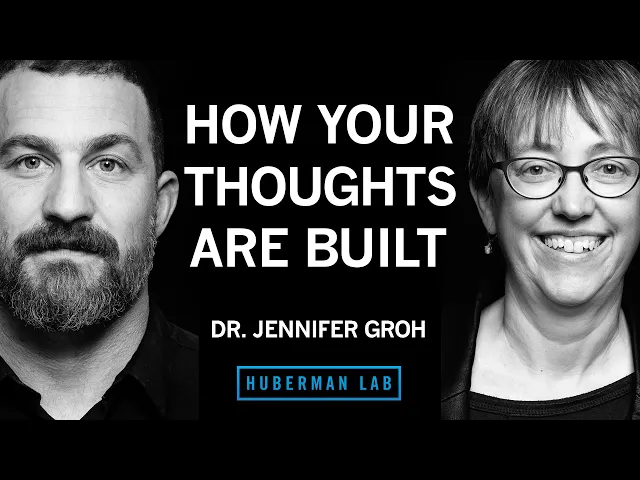
How Your Thoughts Are Built & How You Can Shape Them | Dr. Jennifer Groh
Andrew Huberman
Nov 10, 2025
Episode description
My guest is Dr. Jennifer Groh, PhD, professor of psychology and neuroscience at Duke University. She explains how our brain encodes sights and sounds and integrates them so we can navigate and understand the world around us. She explains what thoughts really are and how what you focus on determines your thoughts, not just in that moment but your future thoughts too. We discuss this in the context of how to improve your level of focus and happiness and how to complete tasks and task-switch more effectively. We also discuss how you can rewire the neural circuits that underlie your default patterns of thinking and attention.
Episode show notes: https://go.hubermanlab.com/8N71cE6
*Thank you to our sponsors*
AGZ by AG1: https://drinkagz.com/huberman
Lingo: https://hellolingo.com/huberman
Wealthfront*: https://wealthfront.com/huberman
Our Place: https://fromourplace.com/huberman
Helix Sleep: https://helixsleep.com/huberman
LMNT: https://drinklmnt.com/huberman
*Follow Huberman Lab*
Instagram: https://www.instagram.com/hubermanlab
Threads: https://www.threads.net/@hubermanlab
X: https://twitter.com/hubermanlab
Facebook: https://www.facebook.com/hubermanlab
TikTok: https://www.tiktok.com/@hubermanlab
LinkedIn: https://www.linkedin.com/in/andrew-huberman
Website: https://www.hubermanlab.com
Newsletter: https://www.hubermanlab.com/newsletter
*Dr. Jennifer Groh*
Academic profile: https://www.neuro.duke.edu/profile/jennifer-m-groh
Making Space (book): https://amzn.to/4hSqkZA
Lab website: https://people.duke.edu/~jmgroh
In the News: https://people.duke.edu/~jmgroh/index.php.html#media-coverage
ResearchGate: https://www.researchgate.net/profile/Jennifer-Groh-2
X: https://x.com/JMGrohNeuro
LinkedIn: https://www.linkedin.com/in/jennifer-groh-316b6032
*Timestamps*
00:00:00 Jennifer Groh
00:03:41 Sounds & Vision, Sensory Integration; Dynamic Maps
00:07:42 Context & Mapping; Screens, Projection & Perception, Ventriloquists
00:13:52 Sound Localization
00:16:53 Sponsors: Lingo & Wealthfront
00:19:50 Hearing Loss & Sound Localization, Ear Folds
00:21:56 Unfamiliarity of Hearing Your Own Voice; Tool: Bone Conduction Headphones
00:26:16 Tool: Headphone Volume & Protecting Hearing
00:28:57 3D Sound, Sound Distance, Thunder, Earthquakes
00:37:24 Sound Integration; Sound Frequency & Distance, Warning Signals
00:44:36 Sponsors: AGZ by AG1 & Our Place
00:47:39 Music, Rhythm, Community & Emotion
00:57:00 Music, Military; Courtship; Evolution of Music & Language
01:02:37 Ears, Visual & Auditory Integration, Sound Localization
01:09:48 Evolution of Visual & Auditory Systems, Music; Brain Controlling Vision
01:15:17 Sponsor: Helix Sleep
01:16:45 Physical Space & Sounds; Cathedrals, Sound Delay
01:22:37 Music, Emotion & Community; Science & Admitting Weakness
01:27:01 Thinking & Sensory Simulations; Forming Thoughts
01:33:18 Attention, Attractor States, Flow States, Tool: Changing Environment
01:37:38 Sounds & Environment for Focus, Attention, Tool: Mental Interval Training
01:44:37 Sponsor: LMNT
01:45:58 Endurance & Interval Mental Work; Mental Rest, Music
01:50:37 Musician, Rehearsal & Performance; Pressure
01:54:16 Chickens; Hypnotizing Chickens, Visual Attention & Focus
02:03:47 Relaxation, Phones & Schools, Boredom, Social Media
02:12:48 Acknowledgements
02:13:58 Zero-Cost Support, YouTube, Spotify & Apple Follow, Reviews & Feedback, Protocols Book, Social Media, Neural Network Newsletter
Disclaimer & Disclosures: https://www.hubermanlab.com/disclaimer
_*This experience may not be representative of other Wealthfront clients, and there is no guarantee of future performance or success. Experiences will vary. Andrew Huberman receives cash compensation from Wealthfront Brokerage for paid testimonials in his podcast, creating a conflict of interest. The Cash Account, which is not a deposit account, is offered by Wealthfront Brokerage LLC, member FINRA/SIPC. Wealthfront Brokerage is not a bank. The base APY is 3.50% on cash deposits as of November 07, 2025, is representative, subject to change, and requires no minimum. If eligible for the overall boosted rate of 4.15% offered in connection with this promo, your boosted rate is also subject to change if the base rate decreases during the 3 month promo period. Funds in the Cash Account are swept to program banks, where it earns the variable APY. Same-day withdrawal or instant payment transfers may be limited by destination institutions, daily transaction caps, and by participating entities such as Wells Fargo, the RTP® Network, and FedNow® Service. New Cash Account deposits are subject to a 2-4 day holding period before becoming available for transfer. Investment advisory services are provided by Wealthfront Advisers LLC, an SEC-registered investment adviser. Securities investments: not bank deposits, bank-guaranteed or FDIC-insured, and may lose value._
Mindsip insights from this episode:
Utilize bone conduction headphones for safe exercise
Bone conduction headphones deliver sound via vibration to the bone in front of your ear, leaving your ears open to hear your surroundings for safety during exercise.

Utilize separate phone for social media to reduce distraction
To manage distraction, you can use a separate, old phone exclusively for social media apps to create physical and logistical friction that prevents impulsive use.

Understand brain's mechanism to manage hearing while speaking
Your brain has an active mechanism to turn down the volume of your hearing just before you speak so you are not overwhelmed by the sound of your own voice.
Address hearing loss to mitigate dementia risk
Hearing loss is correlated with dementia, possibly because less sensory information coming in causes the brain to start turning off circuits.

Visualize thoughts through sensory simulations
The theory of thought is that when you think of something, like a cat, your brain runs small simulations in your sensory areas of what a cat looks, sounds, and even smells like.
Utilize sound echoes to gauge distance
Your brain unconsciously uses the delay between a direct sound and its reflections off surfaces to calculate how far away the sound source is.
Utilize vision to induce hyper-focus in chickens
You can induce a state of hyper-focus in a chicken by drawing a line and placing its beak on it, demonstrating how powerfully vision can drive brain state.

Implement interval training for cognitive tasks
For difficult cognitive tasks like writing, you can try a strategy of producing a small amount of work, like one sentence, and then taking a short, deliberate break.
Utilize satellite communicator for relaxation in the wilderness
Using a satellite communicator like a Zoleo to stay minimally connected in the wilderness can paradoxically lead to more relaxation than being completely out of touch.

Integrate visual and auditory information through eardrum movement
Your eardrum moves in a precise, wave-like pattern with every fast eye movement, which may be the first step in integrating visual and auditory information.

More from
Andrew Huberman
How to Improve Your Memory & Cognitive Function at Any Age | Dr. Alan Castel

Raising a Dog & Mastering Calm Assertive Energy | Cesar Millan

Essentials: Tools for Hormone Optimization in Males | Dr. Kyle Gillett

Movement Practice to Strengthen Your Mind-Body Connection | Ido Portal

Essentials: The Science of Eating for Health, Fat Loss & Lean Muscle | Dr. Layne Norton
You also might be interested in

Jordan Harbinger: Fight-or-Flight, Two Kidnappings, and the Wallet Ruining Your Spine

How Brain Inflammation Drives Depression, Alzheimer's, and Parkinson's

Danny McBride on Leaving Hollywood, the Collapse of Comedy & Doomscrolling’s Impact
Your Nervous System Controls Your Gut, Hormones, and Weight — Here's How to Fix It

I Tried EVERY Legal Focus Drug, Here’s What Actually Works